


Cryptocurrency tax in india 2026 explained – Complete Guide for Beginners
Introduction :
- Cryptocurrrency is no longer a niche topic in India. Millions of people are investing in Bitcoin, Ethereum, and other digital assets. But here’s the problem – most investors don’t understand taxes.
- That’s Dangerous, Because unlike stocks, crypto taxation in India is strict, confusing, and heavily monitored. One mistake can lead to penalties, notices, or even legal trouble.
If you’re buying, selling, trading or earning crypto – you are liable to pay tax.
This Guide will Explain Everything in Simple Language :
- How crypto tax works
- What rules apply in 2026
- How much you need to pay
- Mistakes to avoid
- No Technical jargon, No Confusion.

What is Cryptocurrency Tax in india ?
Cryptocurrency Tax is the tax you pay on profits earned from digital assets like :
- Bitcoin
- Ethereum
- Altcoins
- NFTs
In India, crypto is classified as Virtual Digital Assets (VDA)
This Means :
- it is NOT related like currency
- It is NOT taxed like special asset
Current Crypto Tax Rules in India (2026) :
India Introduced Strict crypto tax rules in 2022, and they still apply in 2026.
Main Rules :
1. Flat 30% Tax on Profits
- No Slab benefit
- No Exemption
2. No Loss Adjustment
- You cannot offset losses
- Loss is useless for tax saving
3. 1% TDS on Trasactions
- Deducted on every transaction
- These rules make crypto one of the highest taxed assets in India.
Table 1 : Cryptocurrency Tax Treatment in India 2026
| Crypto Activity | General Tax Treatment | Important Point |
| Buying Crypto | No immediate VDA transfer tax merely for purchase | Keep acquisition records |
| Selling Crypto | 30% tax on taxable VDA income | Cost of acquisition is relevant |
| Crypto to Crypto Transfer | Can be taxable as a VDA transfer | Don’t assume it is tax free |
| Crypto Loss | Special VDA loss restrictions apply | Cannot be set off against other income |
| VDA TDS | 1% on qualifying transfers | Annual thresholds apply |
| Crypto Gift | Tax treatment depends on the circumstances | Gift rules need to be checked |
| VDA Reporting | Schedule VDA in applicable ITR | Transaction wise reporting required |
Understanding 30% Crypto Tax (Simple Explanation)
Let’s Break it Down :
Example :
- You invest 1,00,000
- Sell for 1,50,000
Profit :
- 50,000
Tax :
- 30% of 50,000 = 15,000
- You Keep 35,000 as Profit
Important :
- Tax applies only on profit
- But losses cannot reduce tax
What is 1% TDS on Crypto ?
- TDS = Tax Deducted at Source
- Every time you sell Crypto :
- 1% of transaction value is deducted
Example :
- Sell 1,00,000 Crypto
- 1,000 deducted as TDS
Why This Matters :
- Reduces Liquidity
- Tracks Transactions
Types of Crypto Transactions & Tax Treatment :
- Buying Crypto
- No Tax
- Selling Crypto
- 30% Tax + 1% TDS
- Trading Crypto (Coin to Coin)
- Tax Applies
- Even if no INR involved
- Receiving Crypto as Gift
- Taxable (if above limit)
- Mining Crypto
- Taxable as income
- Staking Rewards
- Taxable
Crypto Tax Calculation Step-by-Step :
Step : 1
Calculate Total Investment
Step : 2
Calculate Selling Value
Step : 3
Find Profit
Step : 4

Apply 30% Tax
Setp 5 :
Adjust TDS
Do You Need to File Crypto Tax ?
Yes – if :
- You Traded Crypto
- You Earned Profit
- You Received Crypto
- Even small transactions matter
Penalty for Not Paying Crypto Tax :
- Be Careful here
- Consequences :
- Tax Notice
- Penalty
- Interest Charges
- Governemtn is Tracking Crypto Transactions Strictly
How to Report Crypto in ITR :
- Crypto Must be Reorted Under
Income from Other Sources / Capital Gains
Include :
- Buy Price
- Sell Price
- Profit
Common Mistakes to Avoid :
Ignoring Small Transactions
- Not Tracking Trades
- Thinking Crypto is Anonymous
- Avoiding Tax Filing
These mistakes can cost you heavily
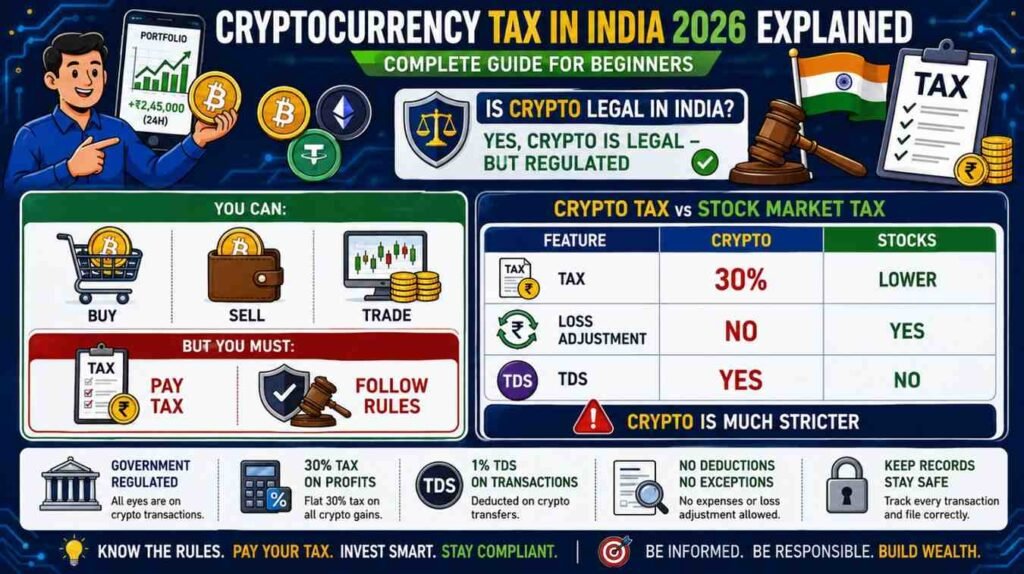
Is Crypto Legal in India ?
Yes, Crypto is Legal – but regulated
You Can :
- Buy
- Sell
- Trade
But You Must :
- Pay Tax
- Follow Rules
Crypto Tax vs Stock Market Tax :
| Feature | Crypto | Stocks |
| Tax | 30% | Lower |
| Loss Adjustment | No | Yes |
| TDS | Yes | No |
Crypto is Much Stricter.
How to Reduce Crypto Tax Legally ?
Let’s be hones – you cannot avoid tax completely
But you can :
- Plan Transactions
- Avoid unnecessary trades
- Keep proper records
Future of Crypto Tax in India :
Government May :
- Modify Tax Rates
- Introduce Regulations
- But strict monitoring will continue.
Table 2 : 30% Tax vs 1% TDS – What’s the Difference?
| Feature | 30%VDA Tax | 1% VDA TDS |
| Purpose | Tax on taxable income from VDA trasfer | Tax deducted at source |
| Applied On | Taxable VDA income | Consideration for qualifying tarnsfer |
| Rate | 30% | 1% |
| When | Calculated as part of final tax liability | Deducted at payment / credit, subject rules |
| Can it be adjusted? | Final tax liability | Available as tax credit, subject to applicable rules |
| Threshold | No general small profit exemption stated under 115BBH | 10,000 / 50,000 annual threshold depending on payer |
| Main Rule | Section 115BBH | Section 194S / corresponding 2026 framework |
Advanced Insights (Important) :
- Exchanges share data with government
- Blockchain is traceable
- Taxation is risky
Don’t take shortcuts
FAQs (Frequently Asked Questions) :
- Is Crypto Taxable in India ?
Yes
- What is Crypto Tax Rate ?
30%
- Can I Avoid Crypto Tax ?
No

- Do I Pay Tax on Loss ?
No, but cannot adjust
- Is TDS Refundable ?
Yes, during ITR
- Is Crypto Legal ?
Yes
- Do Small Investors Pay Tax ?
Yes
- What if i Don’t File Tax ?
Penalty
9. Where should crypto income be reported in the ITR ?
Eligible persons disclose VDA transactions through Schedule VDA
10. Do I need to keep records on my cryptocurrency transactions ?
Yes, Keeping purchase cost, sale value, dates, transaction records and TDS details makes VDA reporting and tax calculation much easier.
Conclusion :
Cryptocurrency taxation in India is strict, simple, and unavoidable.
If you’re investing in crypto, you must understand :
30% Tax Rule
1% TDS No Loss Adjustment
Smart Investors Don’t Just Earn Profits – They Manage Taxes Efficiently.
Sources & References :-
- Income Tax Department – Taxation of Virtual Digital Assets – Current VDA definition, 30% taxation, cost of acquisition rule, TDS and tranasction.
- Income Tax Department – Section 115BBH – 30% tax rate and restrictions on expenditure and loss set off.
- Income Tax Department – VDA TDS Section 194S – 1% TDS, thresholds and who is responsible for deduction.
- Income Tax Department – ITR 2 FAQ – VDA taxation and Schedule VDA reporting information.
- Income Tax Department – Form 141 FAQ – 2026 reporting framework for TDS on VDA transfers.
For More Updates Please Follow Click Here
Article was Last Update On 20th August 2026.