


August 2026 Jobs Report – U.S. Adds 162,000 Jobs, Unemployment Rate at 4.1%
August 2026 jobs report at a glance
The U.S. labor market came back stronger in August after a week July reading.
Employer added 162,000 nonfarm payroll jobs in August according to the U.S. Bureau of Labor Statistics. The unemployment rate stayed at 4.1%, while the number of unemployed people was about 7.0 million.
The number is especially notable because employment growth over the previous 12 months had averaged only 31,000 jobs per month. August was therefore a much stronger month by comparison.
There was another important change hiding in the report. July’s previously reported 23,000 job decline was revised to a 21,000 job increase. June was revised from 20,000 to 31,000. Together, June and July were revised 55,000 jobs higher than previously reported.
So the latest report paints a firmer picture of employment than the earlier data suggested.
What happened in the August 2026 jobs report?
The BLS Employment Situation report uses 2 separate surveys.
The household survey measures employment and unemployment among people
The establishment survey measures payroll employment, hours and earnings at businesses and government agencies.
For August, the establishment survey showed:
- 162,000 nonfarm jobs added
- 4.1% unemployment rate
- 7.0 million unemployed people
- 61.6% labor force participation rate
- 59.1% employment population ratio
- $37.75 average hourly earning for private nonfarm workers
- 3.1% annual wage growth
- 34.4 hours average private sector workweek.
The household survey also showed that employment increased by 569,000 and the civilian labor force increased by 683,000 from July to August.
That combination matters. More people entered the labor force while the unemployment rate remained at 4.1%.
Why the 162,000 jobs number matters
August’s 162,000 job gain was far above the recent monthly trend.
The previous 12 month average was just 31,000 jobs per month. August therefore produced more than 5 times that average.
Economists and investors watch payroll growth because it gives a broad reading of hiring activity across the U.S. economy.
But one month doesn’t tell the whole story.
The labor market had been cooling earlier in the year, and the July report initially showed a decline. The latest revisions changed that picture. July now shows a gain of 21,000 jobs instead of a loss of 23,000.
That’s a difference of 44,000 jobs in the July revision alone.
It also shows why it’s risky to build a strong economic conclusion around the first release of a monthly jobs report. BLS revises employment estimates as more information arrives.
Unemployment rate remains at 4.1%
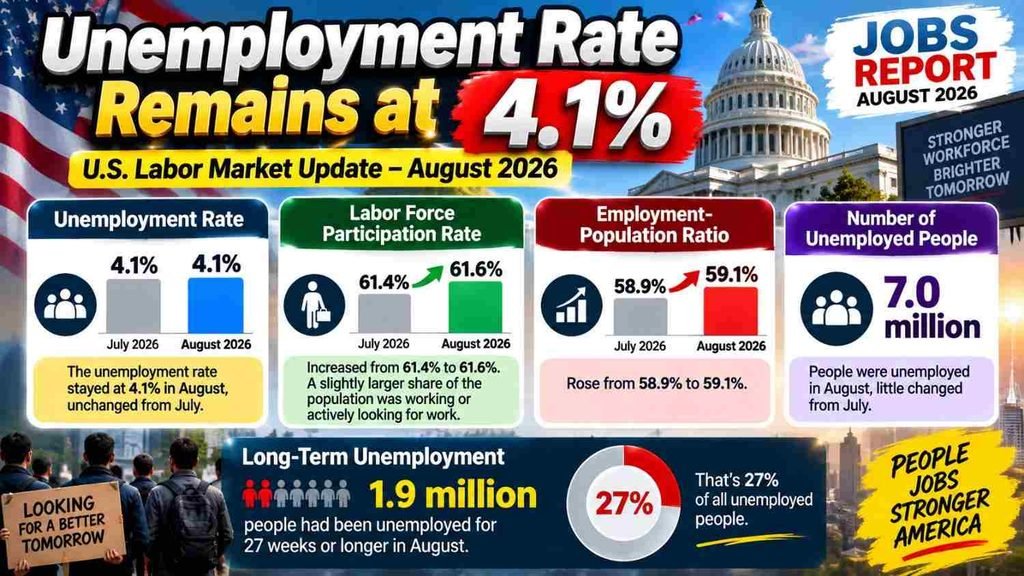
The unemployment rate stayed at 4.1% in August, unchanged from July. The number of unemployed people changed little at approximately 7.0 million.
The labor force participation rate, however, edged up from 61.4% to 61.6%.
That means a slightly larger share of the civilian population was either working or actively looking for work.
The employment population ratio also increased from 58.9% to 59.1%.
For workers, this combination is useful context. The headline unemployment rate didn’t move, but participation and employment both improved.
The long term unemployment figure deserves attention too. About 1.9 million people had been unemployed for 27 weeks or longer, accounting for 27% of all unemployed people in August.
Which industries added the most jobs?
The employment gains weren’t spread evenly across the economy.
Food services and drinking places had the largest increase, adding 59,000 jobs in August. That’s much higher than the industry’s average monthly gain of 12,000 over the previous year.
Local government education added another 42,000 jobs.
Manufacturing payrolls increased by 16,000, continuing an upward that has added 58,000 jobs since a recent low in December 2025.
Health care added 13,000 jobs, although the pace was slower than its 12 month average gain of 32,000 per month.
Construction employment increased by 22,000, with nonresidential specialty trade contractors adding 8,000.

The information industry went in the opposite direction.
Information industry loses 23,000 jobs
Information employment fell by 23,000 jobs in August.
The losses included:
- Computing infrastructure, data processing and web hosting: – 8,000
- Publishing : – 7,000
- Broadcasting and content providers: – 5,000
The information sector had already been losing an average of 8,000 jobs per month over the previous year, so August was weaker than its recent trend.
Financial activities also lost 11,000 jobs in August, according to the detailed establishment date.
Professional and business services added 10,000 jobs, while retail trade added 1,400 and transportation and warehousing increased by 5,000.
The result is a labor market where some industries are still hiring while others are cutting payrolls.
Wage growth in August 2026
Average hourly earnings for private nonfarm employees increased by 10 cents, or 0.3%, in August.
The pushed average hourly earnings to $37.75. Over the previous 12 months, average hourly earnings increased by 3.1%.
For private sector production and nonsupervisory workers, hourly earnings rose 11 cents to $32.53.
The average private sector workweek also edged up to 34.4 hours.
For households, wage growth matters because it affects purchasing power and spending capacity.
For the Federal Reserve, wage data is one part of the larger inflation picture. The jobs report therefore matters beyond employment itself.
What the jobs report means for the Federal Reserve
The Federal Reserve has to balance employment conditions with price stability.
The August jobs report gives policymakers a labor market that looks firmer than the July headline initially suggested.
Payrolls increased by 162,000. July was revised from a loss to a gain. June was revised higher as well. The unemployment rate remained at 4.1%.
That combination gives the Fed more information before its September meeting.
But the jobs report doesn’t determine the Fed’s decision by itself.
Inflation data, wage growth, consumer spending and other economic indicators also matter. The BLS has scheduled the August Consumer Price Index release for September 11, 2026.
So anyone trying to predict the next interest rate move from payroll numbers alone is jumping too far ahead.
What does the jobs report mean for workers?
For people who already have jobs, the August numbers suggest that employment conditions remain relatively stable.
The Unemployment rate is still low by historical standards, and payroll employment increased substantially in August.
But job seekers can have a different experience.
The number of people unemployed for 27 weeks or longer remained around 1.9 million. There were also 5.7 million people outside the labor force who wanted a job but weren’t counted as unemployed because they weren’t actively looking or weren’t available to work.
That’s why the 4.1% unemployment rate shouldn’t be treated as a complete description of every worker’s experience.
Someone working full time and someone searching for work for several months can look very different inside the same national unemployment figure.
What does the report mean for businesses?
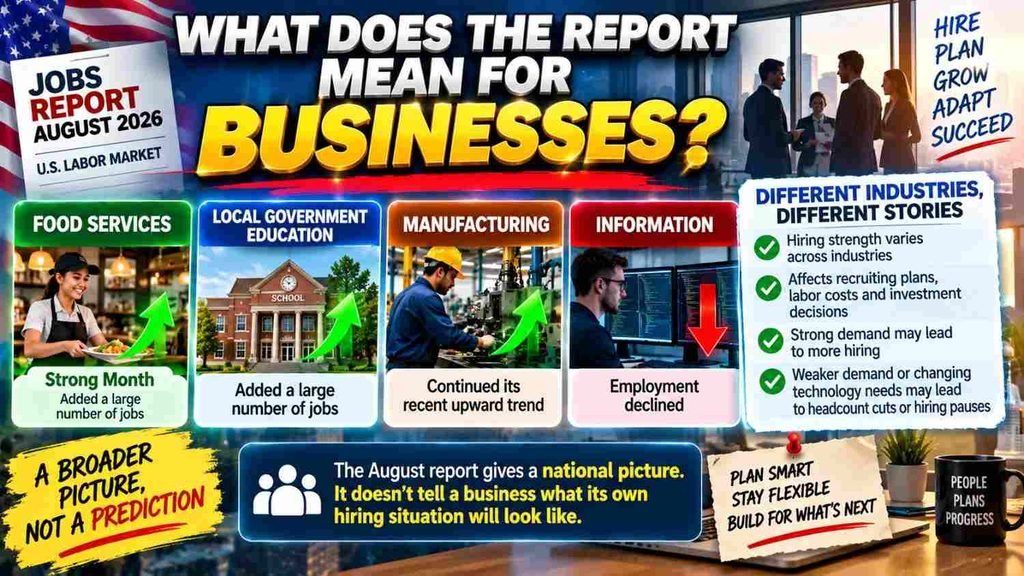
Businesses are still adding workers, but hiring strength differs by industry.
Food services had strong month. Local government education also added a large number of jobs. Manufacturing continued its recent upward trend.
Meanwhile, information employment declined.
For employers, that split can affect recruiting plans, labor costs and investment decisions.

Companies facing strong customer demand may continue hiring. Firms facing weaker demand or changing technology needs may reduce headcount or hold positions open.
The August report gives a national picture. It doesn’t tell a business what its own hiring situation will look like.
August 2026 Jobs report vs July
| Indicator | July 2026 | August 2026 |
| Nonfarm payroll change | +21,000 revised | +162,000 |
| Unemployment rate | 4.1% | 4.1% |
| Labor force participation | 61.4% | 61.6% |
| Employment population ratio | 58.9% | 59.1% |
| Average hourly earnings | Previous Level | $37.75 |
| Average workweek | 34.3 hours | 34.4 hours |
July payroll employment was revised from an initial decline of 23,000 to an increase of 21,000.
August 2026 job gains by major sector
| Sector | August 2026 Change |
| Food services and drinking places | +59,000 |
| Local government education | +42,000 |
| Construction | +22,000 |
| Manufacturing | +16,000 |
| Health Care | +13,000 |
| Professional and business services | +10,000 |
| Transportation and warehousing | +5,000 |
| Information | -23,000 |
| Financial Activities | -11,000 |
Source: U.S. Bureau of Labor Statistics, August 2026 Employment Situation.
What investors should watch next
The jobs report can affect financial markets because employment data influences expectation about economic growth and Federal Reserve Policy.
A stronger labor market can support consumer spending and corporate revenues. It can also keep attention on inflation and interest rates.
That doesn’t mean stocks will automatically rise after a strong jobs report.
Markets react to expectations. If investors already expected strong employment, the actual number may produce a smaller reaction. If the report changes expectations about interest rates, Treasury yields, the dollar and equities can respond.
The August report also shows why revisions matter.
June and July payroll figures were revised upward by a combined 55,000 jobs.
Investors should therefore watch the next revisions rather than treating August’s 162,000 figure as a permanent final number.
Why the jobs report matters to ordinary Americans
You don’t have to work on Wall Street to care about the monthly jobs report.
Employment affects household income, consumer spending and confidence.
Interest rates also affect mortgages, credit cards, auto loans, business borrowing and savings products. If economic data changes expectations about Federal Reserve Policy, borrowing costs can react.
For workers, the most useful numbers aren’t always the headline payroll figure.
Look at wage growth, unemployment, participation, industry hiring and revisions together.
That’s where the broader picture starts to make sense.
The bigger picture after August
The August report gives the U.S. labor market a stronger reading than July’s initial headline suggested.
Payroll employment increased by 162,000. Unemployment remained at 4.1%. Labor force participation increased slightly. Wages rose 3.1% over the year. June and July payroll estimates were revised higher.
Still, there are weaker areas.
Information employment fell sharply, financial activities declined, and long term unemployment remained significant.
That’s why the report doesn’t support a simple ‘everything is strong’ conclusion.
The data points to an economy where hiring has regained some momentum, while conditions remain uneven across industries.
The next major pieces of the economic picture will include inflation date and the Federal Reserve’s Semptember policy decision.
For now, the August jobs report says one clear thing : the U.S. labor market added considerably more jobs than the recent monthly trend suggested, while the unemployment rate held steady at 4.1%.
Frequently Asked Questions
- How many jobs were added in August 2026?
U.S. nonfarm payroll employment increased by 162,000 jobs in August 2026, according to the Bureau of Labor Stastics. - What was the U.S. unemployment rate in August 2026?
The unemployment rate ramained unchanged at 4.1% in August 2026. - How did the August jobs report compare with July?
August was much stronger. Payroll employment increased by 162,000 in August, while July’s employment change was revised to a gain of 21,000 from an initially reported decline of 23,000. - Which industry added the most jobs in August 2026?
Food services and drinking places added the most jobs, with 59,000 positions added in August. - Did the information sector gain jobs in August?
No, information employment declined by 23,000 jobs in August, including losses in computing infrastructure, publishing and broadcasting. - What happened to wages in August 2026?
Average hourly earnings for private nonfarm employees increased 0.3% during August to $37.75. Annual wage growth was 3.1%. - Did the labor force participation rate increase?
Yes, the labor force participation rate edged up from 61.4% in July to 61.6% in August. - Were previous jobs numbers revised?
Yes, June was revised from 20,000 to 31,000 jobs, while July was revised from a loss of 23,000 to a gain of 21,000. Combined, the 2 months were revised 55,000 jobs higher. - Does the August jobs report guarantee a Federal Reserve rate hike?
No, the employment report is one input into Federal Reserve policy. Inflation and other economic data also matter when policymakers decide on interest rates. - When is the next U.S. jobs report?
The BLS has scheduled the September 2026 Employment Situation for October 2, 2026 at 8:30 am. Eastern Time.
Sources & References :-
- U.S. Bureau of Labor Statistics, Employment Situation, August 2026:
Official payroll, unemployment, wages and labor force data. - BLS Current Employment Statistics (CES) : methodology and establishment survey information used for payroll employment data.
- BLS Current Population Survey (CPS) : household employment and unemployment statistics.
- BLS Employment Situation release calendar : Official schedule for upcoming employment reports.
- BLS Consumer Price Index : Upcoming inflation data relevant to interpreting labor market and Federal Reserve policy expectations.
- Reuters, September 4, 2026 : Independent reporting on the August jobs report and financial market reaction.
For More Updates Please Follow Click Here
Article was Last Updated on 6th September 2026.