


Why Nouriel Roubini in 2026 – AI, UBI and His New Dr Boom Forecast
Introduction
The man who predicted the 2008 financial crash is back in the headlines. This time, he’s not warning about a housing collapse or sovereign debt spiral. He’s talking about AI, Universal basic income, and a GDP trajectory that would have sounded like science fiction five years ago.
Nouriel Roubini, the NYU professor emeritus and CEO of Roubini Marco Associates, spent nearly two decades earning the nickname ‘Dr. Doom’. He wore it honestly. But 2026 finds him in a different place, and that shift is exactly why he’s trending right now across financial media, X (formerly Twitter) and economic policy circles in the US.
From ‘Dr. Doom to Something Closer to ‘Dr. Boom’
The nickname started sticking in 2008, when the New York Times labeled him ‘Dr. Doom’ after his housing crash predictions proved right while Wall Street was still laughing. Before that, he called himself ‘Dr. Realist’ Probably more accurate.
But lately? The forecasts have turned noticeably bullish.
In a July 2026 Bloomberg TV appearance that’s now circulating widely, Roubini laid out a scenario where AI and robotics displace a large chunk of the American workforce over the next 20 to 25 years. That sounds gloomy. The twist is he frames it as an economic miracle waiting to happen, if the right policies follow.
He’s explicitly said this is the ‘optimistic’ take.
That’s the part that caught people off guard.
The actual numbers he’s throwing around
Here’s where it gets concrete. In a November report through Hudson Bay Capital, Roubini argued that AI driven productivity gains could push US potential GDP growth from roughly 2% to 4% by the end of this decade. By 2040, he sees 6%. By 2050, potentially 10%.
Those are extraordinary projections. Goldman Sachs, for comparison, sees real potential growth hitting around 2.3% in the early 2030s. Roubin’s 4% blows that out of the water.
His framework : AI isn’t a bubble. It’s a ‘Cambrian Explosion’ of technological advances that compounds across sectors. The US leads in 10 of the 12 industries that will define the nest era of the global economy. That leadership, he argues, produces what he calls ‘American Exceptionalism’ in growth rates, regardless of tariff noise, geopolitical friction, or political turbulence.
‘Tech Trumps Tariffs’, ‘he’s written. Blunt, but that’s the argument.
He’s also pointed out that AI’s productivity boost should outweigh the combined drag from current headwinds by a 4-to-1 ratio. So yes, tariffs hurt. The Iran situation adds volatility. But if AI compounds at the rate he expects, those are speed bumps on a highway.
The other half of the forecast : Massive Unemployment
Here’s where Roubini hasn’t gone soft. The growth story and the job displacement story coexist in his framework, and he’s not pretending otherwise.
On Bloomberg TV in July, he was asked how to fix Social Security, given the trust fund is set to run by 2032. His answer didn’t go where most economists go (raise the retirement age, adjust benefits, means test more aggressively). He said raising the retirement age won’t work because a large poprtion of the working age population will be replaced by AI and robots within 20 to 25 years.
That’s the Social Security conversation most politicians still aren’t having.
Blue collar jobs have been automating for decades. That part of the story is old. What’s different now is white collar displacement. Entry level legal work, financial analysis, software engineering tasks, accounting, mid level management. AI agents are eating into all of it. And unlike the previous wave of automation, this on moves fast.
Roubini sees this playing out across both ends of the labor market simultaneously. GDP climbs. Employment, particularly for middle skill workers, gets squeezed hard.
Where UBI comes in
So what happens to the workers left while GDP accelerates toward 4%?
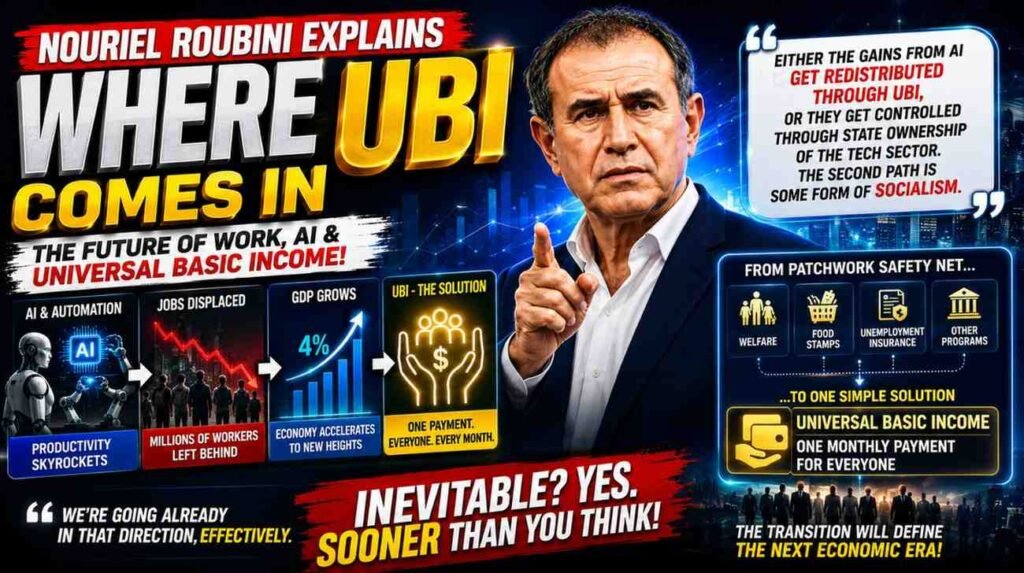
Roubini’s answer : some version of universal basic income. And probably sooner than most people expect.
He’s been public about this at a Bloomberg event, suggesting the current patchwork of US safety net programs (welfare, food stamps, unemployment insurance) could consolidate into a single, broader framework. One monthly payment for everyone. The evolution he describes isn’t sudden. He sees it unfolding over decades, not in the next Congress.
But his reasoning on the inevitability is sharper. When pressed on Bloomberg TV, he said it plainly : either the gains from AI get redistributed after the fact through UBI, or they get controlled at the front end through some form of state ownership of the tech sector. He called that second path ‘some form of socialism’.
His framing : ‘We’re going already in that direction, effectively’.
For an economist who built his name as a free market realist warning about government overreach and debt spirals, that’s a significant statement.
Roubini’s AI Driven GDP Forecast vs Wall Street Consensus (2026-2050)
| Forecast Source | US GDP Growth Target | Timeframe | Key Driver |
| Roubini (Hudson Bay Capital, Nov 2025) | -4% | By end of decade (2030) | AI + AGI productivity compounding |
| Roubini | -6% | By 2040 | AGI adoption across all sectors |
| Roubini | -10% | By 2050 | Full AGI Economic Deployment |
| Goldman Sachs (2026 Outlook) | -2.3% | Early 2030s | AI capex, earnings growth |
| Goldman Sachs (2026 S&P Forecast) | 2.7% GDP Growth | 2026 | AI investments + Fed cuts |
| Bloomberg Consensus (2026) | -2.8% Global, -2.6% US | 2026 | AI infrastructure + fiscal support |
| Morgan Stanley / Slok (Apollo) | Reacceleration in 2026 | Near Term | Tech led recovery post tariff shock |
Why this is trending specifically right now
A few things converged this week.
The Bloomberg TV clip from July 17, 2026 started circulating fast, particularly the part where Roubini connects the Social Security crisis directly to AI displacement rather than just demographics. That framing is unusual. Most of the Social Security conversation in DC stays focused on the boomer retirement wave, not on whether AI makes the concept of a retirement age obsolete.
The clip hits differently because Roubini isn’t a tech optimist from Silicon Valley making this argument. He’s the guy who called the 2008 crash while banks were packaging mortgage securities into AAA rated oblivion. His credibility as a realist, not a hype merchant, makes the UBI or socialism framing land harder.
There’s also the ‘Dr. Droom goes Boom’ angle that financial media loves. The story writes itself.
What the critics say
Not everyone buys the 4% GDP projection. Goldman’s 2.3% figure reflects more measured assumptions about how long AI productivity gains take to show up in aggregate output. The lag between technological capability and measured economic productivity is well documented. Personal computers existed in the 1970s but didn’t show up in productivity numbers until the 1990s.
The counterargument on UBI is also substantial. Funding a universal payment for every American adult requires either significant tax revenue from AI generated profits (which means corporate tax rates to up sharply) or deficit spending at a scale that would make current debates look minor. The political path to any version of UBI in the US remains narrow.
And Roubini himself hasn’t fully abandoned his warning instincts. He’s flagged a K shaped economy in the US, where the gains concentrate at the top while the middle hollows out. That K shape problem gets worse, not better, if AI accelerates growth while eliminating the jobs that middle class Americans actually hold.
The deeper tension in his argument
Here’s what makes Roubini’s position genuinely interesting, and why it’s worth following closely.
He’s making two claims that pull against each other. One: AI is the most powerful growth engine in human history, capable of doubling US GDP growth rates within a decade. Two : that same engine will destroy enough employment that the US needs a fundamental redesign of its social safety net.
Both can be true. Probably are. But they create a political problem that no on in Washington is currently equipped to solve.
The productivity gains from AI will flow to companies and their shareholders first. The job displacement will hit workers immediately. The tax revenue needed to fund UBI won’t materialize until the economy has already absorbed years of labor market disruption.
That timing gap is where the real sits. Not in the long run math, but in the decade between ow and when the system has adjusted.
What this means if You’re a working American
If you’re a white collar professional in the US, Roubini’s forecast is worth taking seriously. The displacement he’s describing targets cognitive work, not just physical labor. Legal research, financial modeling, code review, customer support, data analysis. These are already changing fast.
The UBI conversation matters even if you think it’ll never happen, because it signals where the pressure is building. Private sector AI adoption is accelerating. The public policy response is lagging badly. That gap is where economic pain concentrates.

Roubini’s estimate of 20 to 25 years for large scale displacement sounds long. But AI capability in mid 2026 is already ahead of where most 2023 forecasts placed it in 2027 or 2028. These timelines have a history of compressing.
What Roubini actually means when he says ‘AGI is coming’
Here’s something most coverage of his recent appearances glosses over.
Roubini’s GDP projections (4% by 2030, 6% by 2040, 10% by 2050) aren’t just about current AI tools. They’re built on the assumption that artificial general intelligence, AI that can match or exceed human cognition across domains, arrives within the next decade or so. He’s said as much in several appearances this year. The Cambrian explosion framing only holds if the compounding continues. And compounding at that level requires AGI, not just better chatbots.
That’s bigger bet than it might sound.
Prediction markets and serious research institutions in 2026 are placing meaningful probability on AGI arriving in the 2030s. A RAND Corporation report from March 2026 documented how expert timelines have shifted dramatically toward the near term over the past 5 years. DeepMind’s Shane Legg has publicly put a 50% probability on minimal AGI by 2028. Anthropic CEO Dario Amodei expressed confidence at Davos that AGI level systems are approaching fast.
Roubini’s GDP numbers assume that trajectory. He’s not projecting a world where AI stays as capable as it is today. He’s projecting a world where it gets dramatically smarter, faster, and deployed at scale across every industry simultaneously.
If he’s right about that, the 4% figure might actually be conservative.
If he’s wrong, the redistribution argument still stands, just on a slower timeline.
The Productivity wages gap : The part people aren’t discussing enough
There’s a detail in Roubini’s Bloomberg interview from January 2026 that deserves more attention than it got.
He pointed to data from roughly 6,500 firms showing that most of the AI driven productivity gains are being captured by corporations, not workers. Real wages, he noted, are growing slower than productivity. Labor costs as a share of output are actually falling.
That’s the K shaped economy he mentioned separately. GDP goes up. Corporate earnings go up. And real wages for a large slice of the workforce either stagnate or erode, because the efficiency gains land at the firm level first.
This matters for the UBI argument in a specific way. Roubini frames the redistribution question as eventually necessary, something that unfolds over 20 to 25 years. But the productivity wages gap is already showing up in the data now. The lag between when companies capture AI gains and when workers feel them could be a lot shorter than most people expect.
Goldman Sachs found that roughly 46% of administrative tasks are already automatable with current AI systems. Entry level hiring in some professional services sectors has dropped by nearly 40% since 2024. These aren’t projections. They’re happeing now.
Roubini sees the long arc correctly. The short term pain may arrive on its own faster schedule.
How this plays with the Social Security debate in Washington
Washington is currently having a Social Security conversation that exists almost entirely in the 1990s.
The usual arguments : raise the retirement age, adjust the cost of living formula, means test benefits, raise the payroll tax cap. These are all valid within a framework that assumes stable employment and a growing base of workers paying into the system.
Roubini’s framework breaks that assumption.
If AI displaces large numbers of workers over the next 20 years, the ratio of contributors to beneficiaries collapses regardless of what the retirement age is You can push the official retirement age to 70. If the jobs that 50 and 55 year olds rely on are being automated away, they’re not paying into Social Security either way.
He said this explicitly on Bloomberg in July. Raising the retirement age is insufficient because the problem isn’t people living longer. The problem is that the jobs won’t be there.
So far, almost no politician in Washington has picked up this thread seriously. The 2026 debate over Social Security solvency, with the trust fund heading toward depletion around 2032, is still proceeding as if AI driven displacement is a 2040 problem.
Roubini is arguing, fairly bluntly, that this assumption is wrong.
Where Roubini diverges from the tech optimists
He’s bullish on AI’s economic potential, but he’s not the same flavor of bullish as, say, Silicon Valley CEOs who talk about AI as though disruption and benefit arrive simultaneously for everyone.
His framework is more specific. The gains arrive first for companies and their shareholders. The workers come second, through redistribution, after governments figure out how to tax the winners and transfer the proceeds to the displaced.
That sequencing matters. And it’s where his ‘this is the optimistic scenario’ framing actually makes sense.
The pessimistic scenario, in his view, is that the displacement happens, the gains concentrate at the top, and governments don’t act. That’s the path toward ‘some form of socialism’ by a different route, because public anger over extreme inequality eventually produces political outcomes that are less orderly than a designed UBI policy.
He’s essentially arguing : plan now for redistribution, or get it chaotically later.
That’s a very different argument from ‘AI is good, don’t worry about the workers’. He’s worried about them. He just thinks the answer is a redesigned safety net, funded by taxing AI era winners, rather than trying to slow the technology down.
How to actually use this framework as an American worker or investor
A few things follow practically from Roubini’s framework, even if you don’t accept his exact GDP numbers.
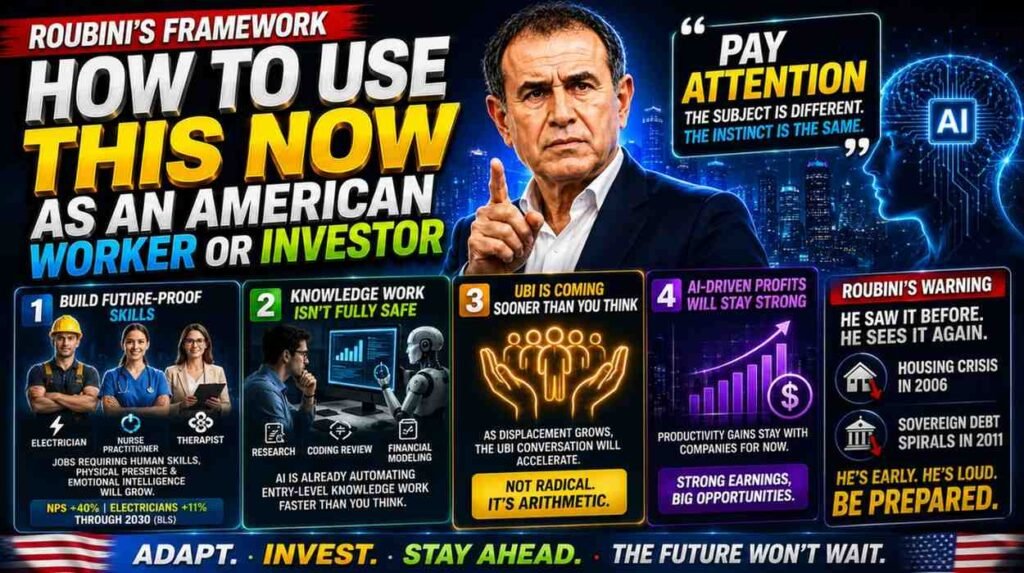
First : the skills most protected from AI displacement are those involving physical presence, high stakes human judgement, or emotional intelligence. Electrician, Nurse practitioner, Therapist. Data from the Bureau of Labor Statistics projects nurse practitioners growing 40% and electricians growing 11% through 2030. Those numbers hold even in a high AI scenario, because AI can’t run wire through a wall or hold a patient’s hand.
Second : Knowledge work is not uniformly safe. Entry level research, analysis, drafting, coding review, and financial modeling are already being absorbed by AI tools at a rate that surprises even people inside the companies deploying them.
Third : the UBI conversation is going to move faster than most people expect. The 2026 political version of that debate (pilot programs, incremental proposals) will look very different in 5 years if displacement data keeps compounding. Roubini doesn’t see it as radical. He sees it as arithmetic.
Fourth : Corporate earnings in AI dominant sectors could run hot for longer than skeptics assume, precisely because the productivity gains are staying at the firm level and not being shared with workers yet. That’s uncomfortable from a social equity standpoint. It’s also, bluntly, what the earnings data shows.
Roubini built his reputation on reading the structural signals that everyone else explains away. Housing in 2006. Sovereign debt spirals in 2011. He was early and loud both times.
He’s being early and loud again. The subject is different. The instinct is the same. Pay Attention.
AI Job Displacement Risk by Sector US Workers (2026 Data)
| Sector / Role Type | Displacement Risk | Key Reason | BLS Growth Outlook |
| Administrative & Office Support | High | 46% of tasks already automatable (Goldman Sachs) | Declining |
| Entry Level Legal / Paralegal Work | High | AI agents performing research and drafting | Declining |
| Financial Analysis / High Accounting | Hgh | Structured, rule based cognitive work | Moderate Decline |
| Software Engineering (Entry High Level) | High | AI code generation accelerating fast | Slowing Significantly |
| Mid Level Management | Moderate – High | Coordination and reporting roles targeted | Flat to declining |
| Customer Service / High Support | High | Already heavily automated via AI agents | Declining |
| Radiologists / Diagnostics | Moderate | AI outperforms on narrow tasks, human oversight still required | Stable |
| Electricians | Low | Physical presence required, licensed trade | +11% projected |
| Nurse Practitioners | Low | Human judgment, Emotional care, physical presence | +40% projected |
| Therapists / Counselors | Low | Relationship dependent, regulatory protection | Growing |
| CEOs / Senior Executives | Low | Strategic judgment, Accountability, stakeholder management | Stable |
| Clergy / Community Roles | Very Low | Deeply relationship and trust dependent | Stable |
Wall Street is already pricing his bullish thesis, whether they credit him or not
Here’s something worth sitting with. Roubini’s core growth argument, AI drives US productivity gains that outweigh every other headwind, is now practically the consensus on Wall Street.
Goldman Sachs raised its S&P 500 year end target for 2026 to 8,000 projecting earnings per share of $340, which represents 24% annual growth. Their analysts expect AI infrastructure investment to account for roughly half of that earning growth. The largest hyperscale tech companies are projected to spend $754 billion on capital expenditures in 2026 alone, up 83% from 2025.
Those numbers make Roubini’s ‘tech trumps tariffs’ thesis look less contrarian and more like baseline reality.
S&P 500 return on equity hit a record 22% in Q1 2026. AI adjacent stocks tied to data center construction returned nearly 60% in the first half of the year. The market is pricing the productivity story in right now, not waiting for GDP data to confirm it.

So when Roubini talks about GDP potentially hitting 4% by 2030, he’s not pitching an outlier view anymore. He’s describing the mechanism behind what investors are already doing with their money.
The interesting divergence is on the distribution side. Wall Street is bullish on AI earnings. Roubini is simultaneously bullish on earnings and worried about who captures them. Those two positions don’t conflict. But most financial media treats them as separate conversations, when they’re the same conversation.
The OpenAI government equity angle nobody expected
One detail from Roubini’s July Bloomberg interview that went somewhat underreported : he referenced a Financial Times report that OpenAI had discussed giving the US government a roughly 5% equity stake as a mechanism for the public to share in AI’s upside.
He said the government is going to end up taking over some fraction of the major tech firms, one way or another. Either through voluntary arrangements like the OpenAI discussion, or through more aggressive policy pressure as displacement accelerates.
That’s a live policy debate in 2026, not a fringe idea : Sam Altman and Elon Musk have both publicly floated some version of UBI or direct payments tied to AI wealth generation. When the CEOs building the technology are endorsing redistribution mechanisms, the political trajectory becomes clearer, even if the timeline stays murky.
Roubini’s version is more specific than most. He sees it playing out as either ex post redistribution (UBI funded by taxing AI winners after the fact) or ex ante redistribution (government ownership stakes in the firms generating the gains). He considers both paths more or less inevitable give the displacement math. The only question is which one arrives first and how well it gets designed.
Given Washington’s track record with proactive policy, most analysts would bet on the chaotic version.
The UBI debate has moved significantly in 2026
Five years ago, UBI was mostly an academic thought experiment with scattered pilot programs in cities like Stockton, California and handful European Countries.
That’s Shifted.
As of mid 2026, UBI sits on the political agenda in ways that would have surprised most 2021 analysts. The displacement fear is driving unusual coalitions : progressive lawmakers who’ve supported direct payments for years are now finding unexpected allies in tech entrepreneurs who see UBI as a pressure valve against public backlash against AI companies.
Critics still have a case. A meaningful UBI for every American adult would cost somewhere between $2 Trillion and $4 Trillion annually, depending on the payment amount. Funding it through taxes on AI era corporate profits would require a tax environment significantly different from today’s. Funding it through deficit spending piles onto debt loads already under pressure.
The pilot program data is also mixed. Small scale UBI experiments show some positives effects on mental health and employment transitions. They don’t resolve the macro funding questio.
But Roubini’s framing sidesteps the purity debate. He’s not arguing for a specific policy design right now. He’s arguing that some version of redistribution is mathematically required if AI delivers on its growth promise, and that the political system will get there eventually, through design or through crisis.
Why is credibility holds eve when specific predictions miss
Roubini has been wrong before. He predicted a global recession in 1999 that didn’t materialize. He’s been more bearish than the data warranted at various points in his career.
His critics are right to note this. A track record that includes one spectacular correct call (2008) and multiple less accurate calls doesn’t make someone an oracle.
What keeps people listening comes down to 2 things.
First, his framework is structural , not tactical. He’s not trying to call the S&P 500 six months out. He’s identifying long term forces, demographic shifts, debt dynamics, technology inflections, and asking what they mean for economic structure over a decade. That kind of analysis is harder to falsify short term and more durable when it’s right.
Second, he publicly updates his views when evidence shifts. The movie from Dr. Doom toward something closer to Dr. Boom isn’t a contradiction. It’s what happens when a realist looks at new data and changes the forecast. Most economists defend and old prediction rather than revise it. Roubini’s willing to take the reputational hit of changing positions, which is actually how good forecasting works.
Torsten Slok at Apollo and Mike Wilson at Morgan Stanley both align with the core Ai driven growth rebound thesis. These aren’t fringe voices. The fact that serious, credentialed analysts are landing in roughly the same place as Roubini on near term AI impact is itself a signal worth tracking.
The question American’s should actually be asking
The disclosure around Roubini’s 2026 forecast has mostly split into 2 camps. One group treats the GDP projections as evidence that AI is good and worries are overblown. Another focuses on the displacement warnings and treats him as a prophet of disruption.
Both readings miss the actual argument.
The question Roubini is raising isn’t whether AI is good or bad. It’s whether American Institutions are fast enough and flexible enough to manage the transition between now and when the gains are widely distibuted.
The 20-25 year displacement timeline sounds long. But policy in the US typically takes a decade just to get from proposal to law. Social Security took years to build after the Depression forced the issue. Medicare took decades of political fighting before it passed.
The gap between when AI displaces worker at scale and when any meaningful policy response arrives could be 10 years wide. That gap is where real economic damage concentrates, not in the long run GDP numbers, but in the decade long transition that most policy frameworks aren’t built to handle.
Roubini calling this the optimistic scenario is worth taking at face value. Because the alternative, where displacement happens and the political system doesn’t respond in time, produces outcomes that are objectively worse. Prolonged unemployment without redistribution. Social Security. Political pressure from both ends of the spectrum pushing toward even less orderly outcomes than a designed UBI.
He’s saying : the good outcome is planned redistribution. The bad outcome is what happens without it.
Most people aren’t ready for either version of that sentence. But the data says they should start thinking about it.
The bottom line
Nouriel Roubini is trending because he’s saying something counterintuitive with a track record that demans you pay attention.
GDP could double its growth rate. AI is the driver. American’s tech dominance makes the US the primary beneficiary globally. And yet: the same force that produces that growth will require the most significant restructuring of American economic life since Social Security was created in 1935.
He calls that Optimistic:
Maybe he’s right that it is. The alternative, where displacement happens without redistribution, probably looks worse.
Whether you label it UBI, extended Social Security, or redistribution from the winners of the AI era to everyone else, the basic math Roubini is doing is worth understanding now. Before the timeline compresses again.
Frequently Asked Questions
- Why is Nouriel Roubini Trending in 2026?
Nouriel Roubini is trending in 2026 because of his bold predictions about artificial intelligence (AI), the future of the U.S. economy, and Universal Basic income (UBI). Known for accurately predicting the 2008 financial crisis, Roubini now believes AI could dramatically accelerate economic growth while simultaneously displacing millions of jobs, sparking widespread debate among economists, policymakers, and investors. - What is Nouriel Roubini’s prediction for AI and the U.S. economy?
Roubini predicts that AI and robotics will significantly boost U.S. productivity over the next two decades. He believes America’s potential GDP growth could rise from around 2% today to 4% by 2030, 6% by 2040, and potentially 10 by 2050. His outlook assumes rapid AI adoption across nearly every major industry. - Why does Nouriel Roubini believe Universal Basic Income (UBI) may become necessary?
According to Roubini, AI automate many cognitive and professional jobs, reducing employment opportunities for millions of workers. As automation expands, he argues that governments may eventually need to introduce some form of Universal Basic Income (UBI) or a similar redistribution system to ensure economic stability and consumer spending. - How could AI impact Social Security in the United States?
Roubini believes AI could fundamentally change the Social Security debate. If automation significantly reduces the number of people employed, fewer workers will contribute payroll taxes, putting additional pressure on the Social Security system. He argues that simply raising the retirement age may not solve the long term funding challenge if AI premanently reshapes the labor market. - Which jobs does Nouriel Roubini believe are most vulnerable to AI?
Roubini suggests that many white collar professionals face growing automation risks, including legal research, accounting, financial analysis, software development, customer service, administrative work, and data analysis. Jobs requiring physical presence, human judgement, healthcare expertise, and emotional intelligence are expected to remain more resilient. - Is Nouriel Roubini optimistic or pessimistic about artificial intelligence?
While Roubini has long been known as ‘Dr. Doom’, his current outlook on AI is surprisingly optimistic. He believes AI could become one of the greatest drivers of economic growth in history. However, he also warns that without effective public policy, AI could widen income inequality and create significant labor market disruption. - Could artificial intellingene really double U.S. economic growth?
Some economists, including Nouriel Roubini, believe AI has the potential to dramatically increase productivity and accelerate long term GDP growth. However, other experts, including analysts at Goldman Sachs, project more moderate gains. The actual outcome will depend on AI adoption, business investment, government policy, and technological progress over the coming decades. - What is the biggest risk in Nouriel Roubini’s AI forecast?
The biggest concern in Roubini’s forecast is the transition period between rapid AI adoption and government policy adaption. While businesses may benefit quickly from AI driven productivity gains, workers displaced by automation could face years of economic uncertainty before new safety net policies or workforce opportunities emerge. Managing that transition effectively may determine whether AI becomes an eonomic success story or a source of widespread inequality.
Sources & References
All date, forecasts, and quotes in this article are drawn from the following publicly available sources, listed by section relevance:
Roubini’s Statements & Repots
- Nouriel Roubini, Bloomberg TV Interview – Bloomberg Money, July 17 2026.
- Roubini, Hudson Bay Capital Report – November 2025, Cited in Fortune, CryptoBriefing, and Yahoo Finance (July 2026)
- Roubini, Financial Times essay – Tech Trumps Tariffs, November 2025. Summarized in Fortune and Yahoo Finance.
- Roubini, Bloomberg TV Interview – Tech Led US Productivity Revolution, January 13,2026
- Roubini, Greenwich Economic Forum, Hong Kong – April 13, 2026. Reported by South China Mornig Post.
- Roubini, Delphi Economic Forum, Greece – 2026. Reported by Benzinga.
Article was Last Updated on 21st July 2026.
For More Updates Please Follow Click Here