

Car Insurance Quotes – How to Compare Rates and Save Money in 2026
What Actually Changes the Price You Pay
Car insurance feels simple until you start comaring quotes.
One company says $118 a month. Another says $247 for almost the same driver and vehicle, Same age. Same car parked in the same driveway every night.
That confuses people fast.
And insurance companies like confusion because confused customers stop comparing prices.
The truth is ugly but useful: insurance pricing is all over the place in the United States right now.
Repair costs climbed hard over the last few years. Medical claims got more expensive. Car theft rose in several states. Modern vehicles are packed with sensors, cameras, and electronics that turn small accidents into giant repair bills.
A cracked bumper used to mean paint work.
Now it sometimes means recalibrating radar systems and replacing cameras that cost more than an old used Honda Civic from 2008.
That money circles back into your premium.
So if you’re searching for car insurance quotes in 2026, you’re entering a market where prices move constantly. And people who compare quotes regularly usually save the most money.
What is a Car Insurance Quote?
A car insurance quote is an estimate of what an insurance company may change you for coverage.
The Quote depends on:
- Your age
- Driving history
- Vehicle
- ZIP code
- Credit history in many states
- Mileage
- Coverage choices
Insurance companies use algorithms that crunch risk date all day long.
One speeding ticket from 18 months ago can shift pricing. So can moving into a different ZIP code. Even changing jobs sometimes affects rates because insurers track commuting distance.
Sounds weird. But that’s how the system works
Why Car Insurance Rates keep Going Up
Drivers across the U.S. noticed rate increases recently.
There are several reasons.
Cars Cost More to Repair
Modern vehicles are expensive to fix
A side mirror on a newer SUV may contain:
- Cameras
- Blind-spot sensors
- Heating systems
- Turn indicators
One damaged mirror can cost over $1000 after labor and calibration.
Insurance companies price that risk into premiums.
Distracted Driving keeps Causing Crashes
Phones changed driving behavior badly.
Insurers track accident data constantly, and distracted driving crashes remain a major issue nationwide.
People glance at texts for 2 seconds and drift into another lane. That’s enough.
Weather Damage is Getting Expensive
Hail storms, floods, hurricanes and wildfires create billions in claims every year.
Drivers in states like Texas, Florida and Colorado often feel these increases faster because weather claims stack up constantly.
Vehichle Theft Changed Insurance Pricing
Certain vehicles became theft magnets after social media theft trends spread online.
Insurance companies reacted fast.
Some models saw sharp premium increases almost overnight.
Types of Car Insurance Coverage Explained Simply
A lot of drivers buy coverage without fully understanding what they selected
That becomes a problem after and accident
Here’s the simple version.
Liability Insurance
Liability coverage pays for damage or injuries you cause to other people
Most states legally require it.
If you rear-end another vehicle and injure someone, liability coverage helps say:
- Medical bills
- Property damage
- Legal costs in some cases
State minimum coverage exists, but minimums are often low compared to real accident costs.
One hospital stay can blow through minimum coverage limits fast.
Collision Coverage
Collision coverage repairs your own car after an accident.
If your vehicle hits:
- Another car
- A pole
- A guardrail
- A wall in parking garage at 2am after a terrible Taco Bell decision
Collision coverage usually helps
Lenders require it on financed vehicles.
Comprehensive Coverage
Comprehensive covers damage unrelated to collisions.
That includes:
- Theft
- Fire
- Hail
- Falling trees
- Animal collisions
- Vandalism
A deer running into your front bumper at highway speed counts here.
And deer absolutely do not care about your insurance deductible.
Uninsured Motorist Coverage
Some drivers carry little or no insurance.
If they hit you, uninsured motorist coverage can protect you from paying huge costs yourself.
A lot of drivers skip this to save money. That gamble gets ugly after serious crashes.
Personal Injury Protection
Some states require personal injury protection, often called PIP
This coverage helps pay medical expenses regardless of who caused the accident
Rules vary by state.

Average Factors That Impact Car Insurance Quotes
| Rating Factor | Impact on Premium | Why It Matters |
| Driving Record | Very High | Tickets and accidents increase risk |
| Age | Very High | Younger drivers typically pay more |
| Vehicle Type | High | Repair costs and theft rates matter |
| ZIP Code | High | Local accident and crime statistics affect rates |
| Credit Score | High | Used by many insurers for risk assessment |
| Annual Mileage | Medium | More driving increases exposure to risk |
| Coverage Limits | High | More protection usually means higher premiums |
| Deductible Amount | High | Higher deductibles often lower premiums |
What affects Car Insurance Quotes the Most
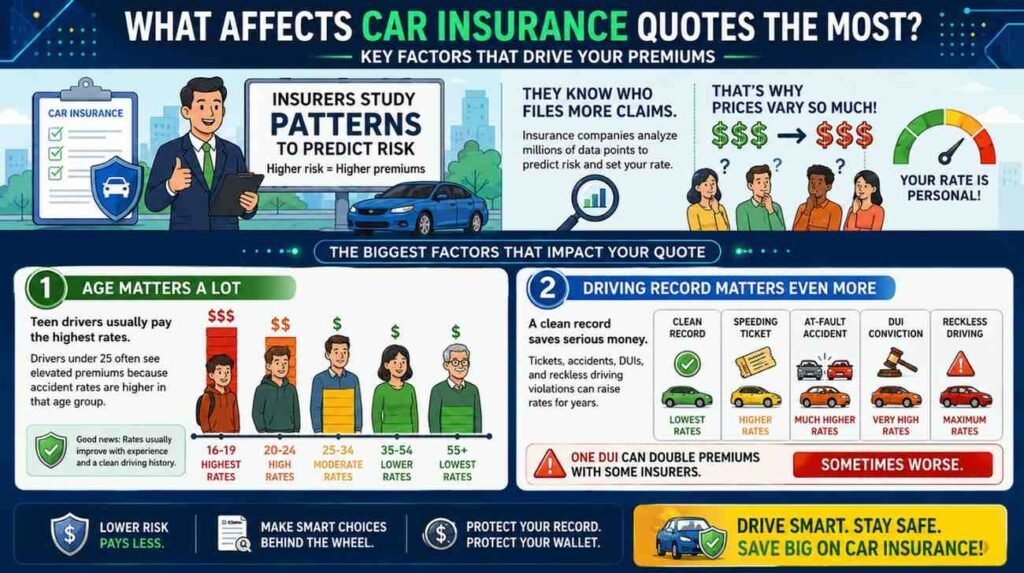
Insurance companies study patterns obsessively.
They already know which drivers file more claims statistically.
That’s why prices vary so much.
Age Matters a Lot
Teen drivers usually pay the highest rates.
Drivers under 25 often see elevated premiums because accident rates are higher in that age group.
Then rates usually improve with experience and clean driving history.
Driving Record Matters Even More
A clean record saves serious money.
Tickets, accidents, DUIs, and reckless driving violations can raise rates for years
One DUI can double premiums with some insurers.
Sometimes worse.
Your Vehicle changes Pricing Heavily
Insurance Companies care about:
- Repair costs
- Theft rates
- Crash history
- Safety scores
- Replacement value
A used Toyota Camry usually costs less to insure than a high-horsepower sports car.
No insurance company sees a Dodge Charger Hellcat and thinks ‘calm decision-maker’.
Your Location Changes Everything
Drivers in crowded cities usually pay more.
More taffic means:
- More accidents
- More theft claims
- More vandalism
- More lawsuits
Even neighboring ZIP codes can produce different rates.
Credit Score matters in Many States
Many Insurers use credit-based insurance scoring.
Drivers with stronger credit histories often pay lower premiums.
People argue about whether that’s fair. Insurance companies still use it heavily.
Best Ways to get Cheap Car Insurance Quotes
This part matters most because many drivers overpay quietly for years.
Some people stay with the same insurer for a decade without checking competitors once.
Insurance companies count on that.
Compare Quotes Regularly
This is the biggest money-saving move.
Quotes shift constantly because insurers change pricing strategies all the time.
A company that was expensive last year may suddenly become competitive.
Drivers who compare quotes every 6 to 12 months usually find better deals.
Increase your Deductible Carefully
Higher deductibles lower monthly premiums
Switching from a $250 deductible to $1000 often cuts costs noticeably.
But you need savings available if something happens.
Otherwise a low monthly payment becomes a financial trap after an accident.
Bundle Policies
Many insurers discount customers who combine:
- Auto insurance
- Home insurance
- Renters insurance
Sometimes the bundle savings are bigger than expected.
Keep Continuous Coverage
Insurance lapses raise red flags.
Drivers without continuous insurance history often pay higher rates later.
Even short gaps can increase pricing.
Ask for Discounts Directly
A lot of discounts never appear automatically
Possible discounts include:
- Safe driver
- Multi-car
- Good student
- Military
- Defensive driving
- Low mileage
- Paperless billing
Always ask, Seriously Ask.
Best-Known Car Insurance Companies in the United States
Several major insurers dominate the market.
Drivers often compare quotes from:
- GEICO
- Progressive
- State Farm
- Allstate
- USAA
- Liberty Mutual
Each insurer prices risk differently.
One company may like suburban family drivers. Another aggressively targets younger drivers. Another heavily penalizes sports cars or past accidents.
That’s why quote comparison matters so much.
Online Quotes vs Local Insurance Agents
Online insurance shopping became huge because people want speed.
You can compare multiple quotes in minutes.
But local agents still help many drivers, especially people dealing with:
- Teen drivers
- Complex policies
- Multiple vehicles
- Claims questions
- High-risk situations
Some drivers want human guidance after accidents. Others want the cheapest policy possible without phone calls.
Both approaches work.
Full Coverage vs Minimum Coverage
People misunderstand this constantly.
Minimum coverage usually protects other people only.
Full coverage generally includes:

- Liability
- Collision
- Comprehensive
If your financed car gets totaled and you only carried minimum liability insurance, you may still owe money on a vehicle you can’t drive anymore.
That situation wrecks budgets fast.
Why Young Drivers Pay So Much
Teen drivers scare insurance companies statistically.
Accident rates are higher. Risk-taking behavior is higher. Distracted driving incidents are higher.
Insurance pricing reflects that reality brutally.
Young drivers can lower costs by:
- Staying on family policies
- Driving safer vehicles
- Maintaining good grades
- Avoiding performance cars
- Taking defensive driving courses
A 17-year old driving a used Honda Accord usually pays much less than someone driving a new sports coupe.
Ways to Save Money on Car Insurance in 2026
| Money-Saving Strategy | Potential Savings | Best For |
| Compare Multiple Quotes | High | All Drivers |
| Bundle Auto and Home Insurance | High | Homeowners |
| Increase Deductible | Medium to High | Drivers with Emergency Savings |
| Maintain Clean Driving Record | High | Long term Savings |
| Ask for Discounts | Medium | Students, Military, Safe Drivers |
| Drive Fewer Miles | Medium | Remote Workers |
| Improve Credit Score | Medium to High | States Using Credit Based Pricing |
| Review Coverage Annually | Medium | Existing Policyholders |
Car Insurance after Accidents
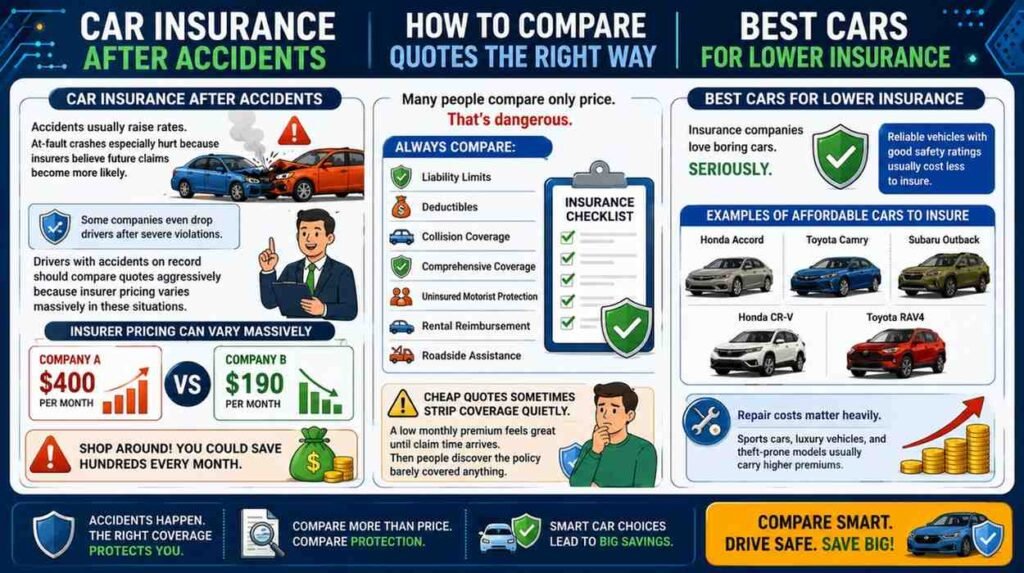
Accidents usually raise rates.
At-fault crashes especially hurt because insurers believe future claims become more likely.
Some companies even drop drivers after severe vilolations.
Drivers with accidents on record should compare quotes aggressively because insurer pricing varies massively in these situations.
Once company might quote $400 monthly while another quotes $190.
How to Compare Car Insurance Quotes Correctly
Many people compare only price
That’s dangerous.
Always compare:
- Liability limits
- Deductibles
- Collision coverage
- Comprehensive coverage
- Uninsured motorist protection
- Rental reimbursement
- Roadside assitance
Cheap quotes sometimes strip coverage quietly.
A low monthly premium feels great until claim time arrives.
Then people discover the policy barely covered anything.
Best Cars for Lower Insurance Costs
Insurance companies love boring cars.
Seriously.
Reliable vehicle with good safety ratings usually cost less to insure.
Examples often include:
- Honda Accord
- Toyota Camry
- Subaru Outback
- Honda CR-V
- Toyota RAV4
Repair costs matter heavily.
Sports cars, luxury vehicles, and theft-prone models usually carry higher premiums.
Common Mistakes People make with Car Insurance
Drivers repeat the same mistakes constantly.
Choosing State Minimum Coverage Blindly
Minimum coverage may satisfy legal requirements while still leaving huge financial exposure after accidents.
Ignoring Deductibles
Some drivers choose ultra-low deductibles without realizing how much it raises monthly costs.
Never Reviewing Policies
Life Changes
Marriage, Moving, Better Credit, Lower Mileage, or Paying off loans can all change insurance pricing.
Letting Policies Lapse
Coverage gaps hurt rates badly.
Hiding Information
Insurance companies verify information carefully.
Incorrect mileage estimates or missing drivers can create claim problems later.
When Should you shop for New Car Insurance Quotes?
Good times to compare quotes include:
- Before policy renewal
- After moving
- After marriage
- After buying a new car
- After improving credit
- After turning 25
- After removing a teen driver
Insurance companies constantly adjust rates.
Checking once yearly can save hundreds.
Sometimes more.
Final Thoughts on Car Insurance Quotes
Car Insurance feels annoying until you actually need it.
Then coverage details suddenly matter a lot.
The drivers who save the most money usually do a few things consistently:
- Compare quotes regularly
- Maintain clean driving records
- Choose sensible coverage
- Ask for discounts
- Avoid unnecessary claims when possible
And one thing matters more than people expect: patience during quote shopping.
Spending 45 minutes comparing rates can save hundreds of even thousands yearly.
That’s decent pay for sitting on your couch clicking tabs.
Frequently Asked Questions (FAQs)
- How can I get the cheapest car insurance quotes?
The best way to get cheap insurance is to compare rates from multiple insurers, maintain a clean driving record, increase deductibles when appropriate, and take advantage of available discounts such as safe driver, multi policy and low mileage discounts. - Why are car insurance rates increasing in 2026?
Car insurance premiums are rising due to higher vehicle repair costs, increased accident claims, severe weather events, medical inflation, and vehicle theft trends across the United States. - What information do I need to get a car insurance quote?
Most insurers require your driver’s license information, vehicle details, ZIP code, driving history, annual mileage, and desired coverage limits to generate an accurate quote - Does comparing car insurance quotes affect my credit score?
No, Most of insurance quote comparisons involve a soft credit inquiry, which does not impact your credit score. - What is the difference between liability and full coverage insurance?
Liability insurance covers damages and injuries you cause to others, while full coverage generally includes liability, collision, and comprehensive protection for your own vehicle as well. - Which car insurance company offers the lowest rates?
There is no single insurer that is always the cheapest. Companies like GEICO, Progressive, State Farm, USAA, and Allstate may offer different rates depending on you age, location, driving record, and vehicle. - How often should I compare car insurance quotes?
Most experts recommend comparing quotes every 6 to 12 months and whenever major life changes occur, such as moving, getting married, buying a new vehicle, or improving your credit score. - Does my credit score affect car insurance rates?
In many U.S. states, insurance companies, use credit based insurance scores when determining premiums. Drivers with stronger credit histories often qualify for lower rates. - Can I lower my car insurance premium after an accident?
Yes. Shopping around, improving your driving record over time, completing defensive driving courses, and maintaining continuous coverage can help reduce premiums after an accident. - What is the best coverage amount for car insurance?
The best coverage depends on your assets, vehicle value, and financial situation. Many drivers choose coverage limits higher than state minimum requirements to better protect themselves from expensive claims.
Sources & References :-
- Insurance Information Institute (III)
- National Highway Traffic Safety Administration (NHTSA)
- Federal Highway Administration (FHWA)
- National Association of Insurance Commissioners (NAIC)
- Consumer Financial Protection Bureau (CFPB)
- Federal Emergency Management Agency (FEMA)
- Kelley Blue Book (KBB)
- J.D. Power Auto Insurance Studies
- LexisNexis Risk Solutions
- U.S. Bureau of Labor Statistics (BLS)
Article was Last Updated on 26th June 2026.
For More Updates Please Follow Click Here