

Car Insurance Lawyer – When You Actually Need One
i’ve been writing about insurance, claims and accident recovery for a long time. Long enough to watch the same story play out hundreds of times.
Someone gets rear-ended at a light. Calls their insurer. Gets a friendly adjuster who sounds like a neighbor. Six weeks later, they’re staring at at settlement offer that wouldn’t cover the rental car, let alone the herniated disc.
Then they Google “car insurance lawyer‘ at 11 pm.
That’s usually too late to get the best outcome. Now always. But often.
So let’s talk about when you actually need one of these lawyers, when you don’t, what they charge, and how to spot the difference between a real one and someone running a billboard farm.
What a car insurance lawyer actually does
A car insurance lawyer is a specific kind of attorney. Most of them are personal injury lawyers with a focus on insurance disputes. Some are pure insurance lawyers who handle property damage, coverage fights, and bad faith claims without much injury work.
The job breaks down into a few buckets:
- Fighting denied claims: Your insurer says the accident isn’t covered. The lawyer reads the policy, finds the exclusion they’re hiding behind, and argues it doesn’t apply
- Negotiating lowball settlements. The insurer offers you $4000 for an injury that will cost $40000 in medical care. The lawyer makes the case for the real number.
- Suing for bad faith. When an insurer behaves so badly that they violate state law, the lawyer turns the claim into a separate lawsuit against the carrier. These can be huge.
- Handling third-party claims. You got hit. The other driver’s insurance is dragging its feet, denying liability or pretending their driver wasn’t at fault. The lawyer makes them pay.
- Coverage disputes: UM/UIM (Uninsured/Underinsured Motorist) claims, stacking arguments, who’s a covered driver, whether the policy was in force. Boring on paper. Worth a lot of money in practice.
That’s the menu, Most cases involve 2 or 3 of these at once.
When you genuinely need to call one
Here’s the honest version. You don’t need a lawyer for every fender bender. You’d be wasting your money and theirs.
You probably need one if any of this is true:
- You were injured. Even a ‘minor’ injury. Soft issue damage, whiplash, back pain that shows up 3 days later. Medical bills compound fast and insurers know it.
- The other driver’s insurer denied liability. They’re claiming you were at fault, or partly at fault, and the police report doesn’t clearly back them up.
- Your own insurer denied your claim. Especially if the denial letter cites a vague reason like ‘material misrepresentation’ or ‘exclusion under section 4.2’.
- The settlement offer feels insulting. If the math doesn’t add up (medical bills + lost wages + repair costs > the offer), it’s not a real offer. It’s an opening bid disguised as a final one.
- Someone died, or someone might be permanently injured. Stop regarding this article. Call a lawyer this afternoon.
- You’re being sued. The other driver is going after you personally because their damages exceed policy limits. Your insurer has to defend you, but you want a second set of eyes.
- The accident involves a commercial vehicle, rideshare, or government vehicle. These cases have weird rules, multiple policies, and shorter deadlines.
If none of these apply, you can probably handle the claim yourself. Read your policy. Ask the adjuster to put everything in writing. Don’t sign anything that says ‘release’ until you’ve thought about it.
When you don’t need one
Some cases really are simple.
You bumped a parked car. You filed a claim. Your insurer paid for the damage. Done.
You got rear-ended in a parking lot, no injuries, the other driver’s insurer accepted full liability within a week, and the repair estimate matches their offer. Done.
Hiring a lawyer here costs you a percentage of a settlement that was going to happen anyway. That’s not a service. That’s a tax.
The honest test : If you can describe the damage, the offer covers everything, and nobody got hurt, you don’t need a lawyer. You need 20 minutes and a follow-up email.
What the cost (and why this isn’t as scary as it sounds)
Most car insurance lawyers work on contingency. That means they don’t get paid unless you do.
The standard fee is 33% of the settlement if it resolves before a lawsuit is filed, and 40% if a lawsuit is filed. Some lawyers charge 25% on pre-suit cases. Some go higher than 40% if the case goes to trial or appeal.
Costs are separate from fees. Expert witnesses, court filing fees, deposition transcripts, medical record retrieval. These come out of the settlement, usually before the lawyer’s percentage is calculated, but read your fee agreement carefully because some firms calculate it the other way (and that’s worth thousands).

The math people miss: a lawyer who gets you $60000 and keeps $20000 left you with $40000. Insurers tend to settle for 3 to 5 times more when a lawyer is involved than when they’re dealing with you directly. Not always. But often enough that the math usually works.
Coverage disputes and bad faith cases sometimes run on hourly billing, especially if there’s no injury involved. Hourly rates for insurance lawyers in most US markets run $250 to $600 an hour. Get an estimate in writing before you agree.
When You Need a Car Insurance Lawyer vs When You Don’t
| Situation | Hire a Car Insurance Lawyer? | Why |
| Minor fender bender with no injuries | Usually No | Claims are straightforward and can often be handled directly with the insurer |
| Vehicle damage fully covered by insurance | Usually No | if repairs are approved and paid without dispute, legal help rarely needed |
| Soft tissue injuries or whiplash | Yes | Medical costs can increase over time and insurers often undervalue these claims |
| Serious injuries requiring ongoing treatment | Definitely | Future medical expenses, lost income, and pain and suffering must be properly calculated |
| Insurance claim denied | Yes | A lawyer can challenge the denial and review policy language for coverage |
| Low settlement offer | Yes | Attorneys can negotiate for compensation that better reflects actual damages |
| Disputed fault of liability | Yes | Legal representation helps gather evidence and protect your rights |
| Uninsured or underinsured driver involved | Yes | UM/UIM claims can be complex and often require legal guidance |
| Commercial truck or rideshare accident | Definitely | Multiple insurance policies and parties may be involved |
| Wrongful death or permanent disability | Immediately | These high value claims require experienced legal representation |
Common Insurance Company Tactics vs Lawyer Responses
| Insurance Company Tactic | How a Lawyer Responds |
| Requests a recorded statement | Advises what to say or declines unnecessary statements |
| Offers a quick settlement | Evaluates future damages before accepting |
| Delays claim processing | Sends formal demand letters and enforces deadlines |
| Blames pre existing injuries | Uses medical experts and records to challenge claims |
| Denies liability | Collects evidence and builds a fault based case |
| Cites confusing policy exclusions | Reviews policy language and disputes improper denials |
| Pressures claimant to sign a release | Prevents premature settlement and protects future claims |
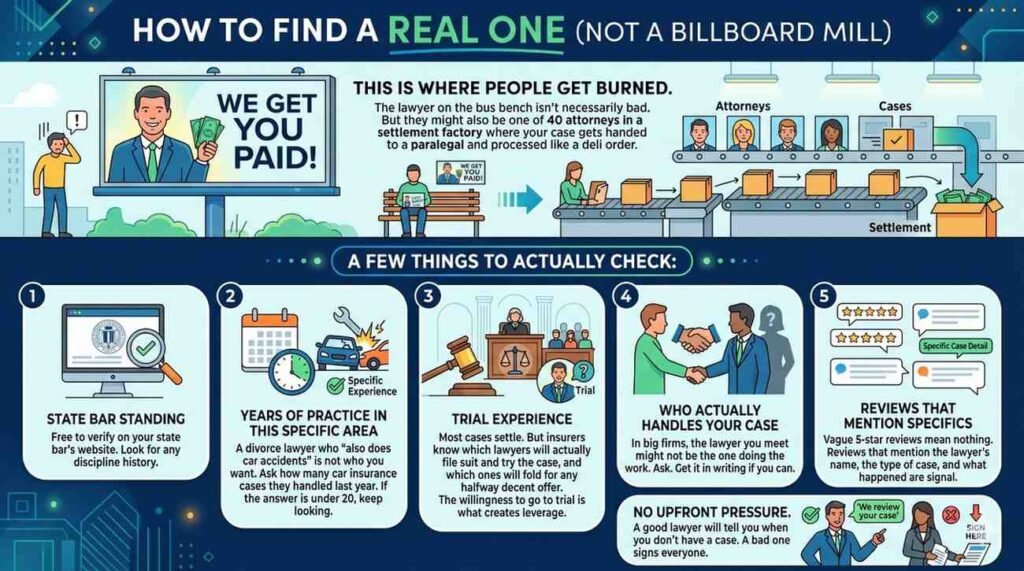
How to find a real one (not a billboard mill)
This is where people get burned.
The lawyer on the bus bench isn’t necessary bad. But they might also be one of 40 attorneys in a settlement factory where your case gets handed to a paralegal and processed like a deli order.
A few things to actually check :
State bar standing. Free to verify on your state bar’s website. Look for any discipline history.
Years of practice in this specific area. A divorce lawyer who ‘also does car accidents’ is not who you want. Ask how many car insurance cases they handled last year. If the answer is under 20, keep looking.
Trial experience. Most cases settle. But insurers know which lawyers will actually file suit and try the case, and which ones will fold for any halfway decent offer. The willingness to go to trial is what creates leverage.
Who actually handles your case. In big firms, the lawyer you meet might not be the one doint the work. Ask. Get it in writing if you can.
Reviews that mention specifics. Vague 5-star reviews mean nothing. Reviews that mention the lawyer’s name, the type of case, and what happened are signal.
No upfront pressure. A good lawyer will tell you when you don’t have a case. A bad one signs everyone.
The bad faith angle most people don’t know about
This is the part that changes the math.
In most US states, insurers owe their policyholders a ‘duty of good faith and fair dealing’. If they violate that duty (denying a valid claim without investigation, dragging out payment to pressure you into settling, refusing to defend you when they should), you can sue them separately.
Bad faith damages can include:
- The full amount of the original claim
- Emotional distress damages
- Attorney’s fees (the insurer pays your lawyer)
- Punitive damages, which in some states are uncapped
I’ve seen $15000 claims turn into seven-figure bad faith verdicts. Not common. But real.
The reason this matters: even the threat of a bad faith claim changes how an insurer treats you. The moment a lawyer who’s known for bad faith litigation enters the picture, your file moves from a regular adjuster to senior claims handling. Suddenly the offer triples.
That’s not magic. That’s just the carrier’s internal risk pricing kicking in.
Common moves insurers make (and how a lawyer counters them)
Some patterns i’ve watched play out for years:
The recorded statement trap. The other driver’s insurer calls within 48 hours and asks for a ‘quick statement, just for our records’. Annoying you say will be used against you. A lawyer will either decline the statement entirely or sit with you through it

The early statement offer. Before you know the full extent of your injuries, they offer you something that feels like a lot. $5000 in your bank account looks great until your MRI comes back three weeks later and you need surgery. Once you can sign the release, you cannot reopen the claim. A lawyer will not let you sign before you’ve reached ‘maximum medical improvement’, whichi is the point where doctors can predict your long-term prognosis.
The independent medical exam. The insurer sends you to ‘their’ doctor. That doctor’s job, in many cases, is to write report saying your injuries are pre-existing, exaggerated, or unrelated to the accident. A lawyer will prep you for what to expect and counter the report with your own medical experts.
The delay game. They don’t deny. They just don’t respond. Weeks become months. Bills pile up. Eventually you’ll take anything. A lawyer puts the carrier on a clock with formal demand letters and statutory deadlines.
The policy-limits dodge. When the at-fault driver’s policy is small ($25000) and your damages are larger, the carrier might tender the limit quickly to close the file. Accepting too fast can waive your right to go after the driver personally or pursue your own UIM coverage. This is exactly the kind of thing people miss without a lawyer.
First 72 Hours After a Serious Accident
| Action | Priority |
| Seek Medical Attention | Critical |
| Take Photos of Vehicles and Injuries | Critical |
| Obtain Police Report Number | Critical |
| Notify Your Insurer | High |
| Keep All Receipts and Medical Records | High |
| Avoid Social Media Posts about the Accident | High |
| Do Not Give a Recorded Statement to the Other Insurer | Critical |
| Schedule a Free Consultation with a Lawyer If Injured | Recommended |
What to do in the first 72 hours after a serious accident
Quick checklist. This is the part to screenshot.
- Get medical attention. Even if you feel fine. Adrenaline masks injuries for hours or days.
- Photograph everything. Vehicles, the scene, your injuries, the other driver’s license and insurance card, road coditions.
- Get the police report number and request a copy.
- Notify your own insurer. Brief facts only. No speculation about fault.
- Do not give a recorded statement to the other driver’s insurer.
- Do not post about the accident on social media. Not ‘ I’m okay ‘. Not anything. insurers monitor.
- Keep every receipt and medical record. Mileage to appointments counts too.
- If you’re injured or unsure, consult a lawyer. Most do free initial consultations.
That last one is genuinely free. There’s no reason not to use a consultation to figure out whether you have a case worth pursuing.
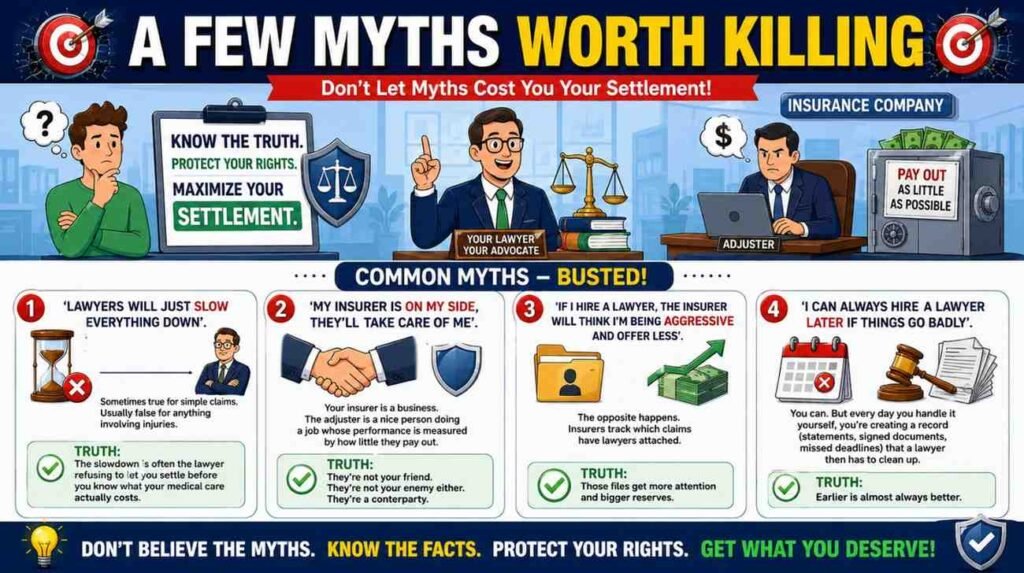
A few myths worth killing
‘Lawyers will just slow everything down’. Sometimes true for simple claims. Usually false for anything involving injuries. The slowdown is often the lawyer refusing to let you settle before you know what your medical care actually costs.
‘My insurer is on my side, they’ll take care of me’. Your insurer is a business. The adjuster is a nice person doing a job whose performance is measured by how little they pay out. They’re not your friend. They’re not your enemy either. They’re a conterparty.
‘If i hire a lawyer, the insurer will think I’m being aggressive and offer less’. The opposite happens. Insurers track which claims have lawyers attached. Those files get more attention and bigger reserves.
The honest bottom line
Most car insurance claims don’t need a lawyer. The ones that do, really do.
The line between the two categories isn’t about how dramatic the accident looked. It’s about injuries, denied coverage, lowball offers, and whether anyone is acting in bad faith.
If you’re sitting there reading this because something feels off about how your claim is being handled, that feeling is usually right. Get a free consultation. Bring your policy, the denial letter or settlement offer, your medical records, and the police report. A good lawyer will tell you in 30 minutes whether you have something worth pursuing or whether you should just take the deal and move on.
Either way, you’ll know.
And knowing beats wondering at 11pm.
FAQs (Car Insurance Lawyer)
- How much does a lawyer charge for a case in India ?
Lawyer fees in India vary depending on the complexity of the case, the lawyer’s experience and location. Some lawyers charge a fixed fee, while others charge per hearing or on a retainer basis. For accident and insurance-related matters, fees can range from a few thousand rupees to significantly higher amounts for complex litigation. - What are the Top 3 Claims for Car Insurance?
The three most common car insurance claims are:
A) Accident Damage Claims – Repairs resulting from collisions with other vehicles or objects.
B) Theft Claims – Compensation when a vehicle is stolen and not recovered.
C) Natural Disaster Claims – Damage caused by floods, storms, hail, earthquakes, or other covered natural events. - Can i fight my own case without a lawyer?
Yes, you can represent yourself in many legal matters. However, insurance companies and their lawyers handle claims every day. Without legal experience you may miss important deadlines, overlook valuable evidence, or accept a settlement that is lower than what your case is worth. - Can I Claim Car Insurance after repair ?
In most cases, you should notify your insurance company and obtain approval before starting repairs. If you repair the vehicle first without proper documentation, inspection, or authorization, the insurer may reduce or deny your claim. Always take photos, keep invoices, and follow your insurer’s claim procedures. - Is it worth getting a lawyer for a car insurance claim?
For minor property damage claims, a lawyer may not be necessary. However, if injuries, disputed liability, denied claims, or low settlement offers are involved, a car insurance lawyer can help maximize compensation and protect your rights. - When Should I hire a car insurance lawyer after an accident ?
You should consider hiring a lawyer as soon as possible after a serious accident, especially if there are injuries, significant vehicle damage, or disagreements with the insurance company. Early legal guidance can help avoid costly mistakes. - Can a lawyer help if my insurance claim was denied?
Yes, A car insurance lawyer can review the denial, gather supporting evidence, negotiate with the insurer, and if necessary, take legal action to pursue the compensation you may be entitled to receive. - How much can a car insurance lawyer increase my settlement?
Every case is different, but studies and industry data often show that claimants represented by attorneys receive higher settlements than those who negotiate with insurance companies on their own. - What should I do before speaking to an insurance adjuster?
Before giving a recorded statement, gather accident details, photos, medical records, and repair estimates. Avoiding admitting fault and consider consulting a lawyer if injuries or significant damages are involved. - What happens if the insurance company offers a low settlement?
You do not have to accept the first offer. A lawyer can evaluate whether the settlement fairly covers medical expenses, lost wages, property damage, and future costs, then negotiate for higher amount.
Sources & References :-
- Insurance Information Institute (III)
- National Association of Insurance Commissioners (NAIC)
- Nolo Legal Encyclopedia
- American bar Association (ABA)
- FindLaw Legal Resources
- Cornell Law School – Legal Information Institute (LII)
- Consumer Financial Protection Bureau (CFPB)
- State Insurance Department Websites
Article was Last Updated on 25th June 2026.
For More Updates Please Follow Click Here