


Senior Citizen Savings Scheme 2026 – Interest Rate, Benefits & Complete Guide
Introduction :
When people retire, one fear becomes real – regular income stops, but expenses don’t. Medical costs increase, lifestyle needs continue, and financial stability becomes the top priority. This is exactly where the Senior Citizen Savings Scheme (SCSS) plays a crucial role.
SCSS is one of the safest and most reliable government-backed investment schemes in India, designed specifically for individuals aged 60 and above. It offers guaranteed returns, regular income, and zero market risk, making it one of the best options for retirees who wan peace of mind.
But here’s the reality – most people don’t fully understand how SCSS works. They either invest blindly or miss better strategies that could maximize returns.
In this detailed guide, you’ll learn everything – from interest rates and eligibility to advanced strategies and mistakes to avoid.
What is Senior Citizen Savings Scheme (SCSS) ?
The Senior Citizen Savings Scheme is Government-backed savings plan that provides secure and stable income after retirement.
It is Managed by :
- Post Offices across India
- Authorized Banks
The main goal of SCSS is simple :
Provide Financial Security to Senior Citizens with fixed and reliable returns.
Unlike risky investments like stocks or mutual funds, SCSS ensures :
Guaranteed Interest
Regular Payouts
Capital Safety
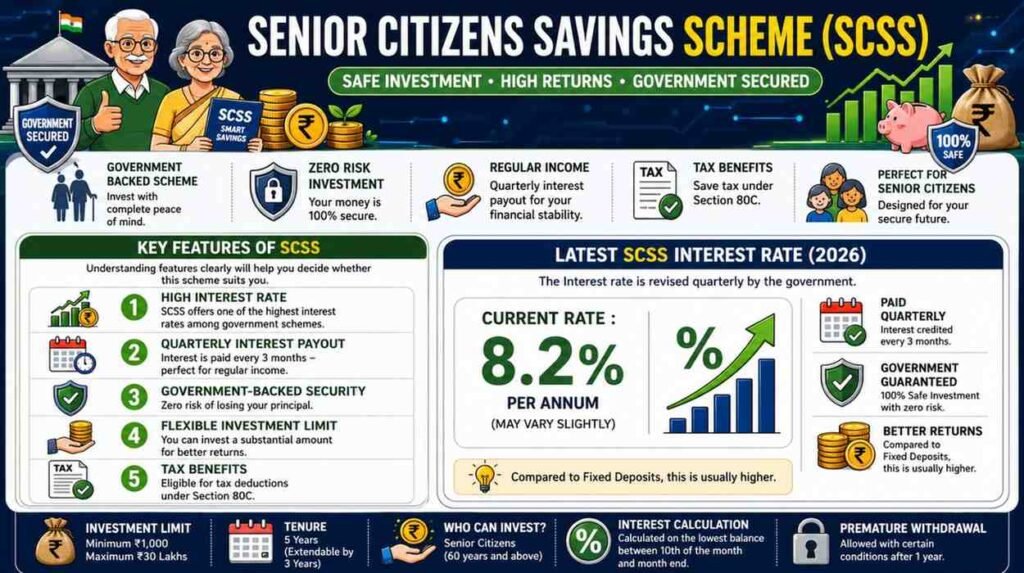
Key Features of SCSS :
Understanding features clearly will help you decide whether this scheme suits you.
1. High Interest Rate
SCSS offers one of the highest interest rates among government schemes
2. Quarterly Interest Payout
Intereset is paid every 3 months – perfect for regular income
3. Government-Backed Security
Zero risk of losing your principal.
4. Flexible Investment Limit
You can invest a substantial amount for better returns
5. Tax Benefits
Eligible for tax dedections under Section 80C
Latest SCSS Interest Rate (2026)
The Interest rate is revised quareterly by the government
Current Rate : Around 8.2% per annum (may vary slightly)
Paid Quarterly
Compared to Fixed Deposits, this is usuallyl higher.
Eligibility Criteria :
Before Investing, you must meet these conditions
Age Requirements :
- 60 years and above
- 55-60 years (if retired under VRS or superannuation)
Special Cases :
Defense pesonnel can invest earlier
If you don’t meet eligibility, you cannot open an SCSS account.
Investment Limits :
Minimum Investment :
1,000
Maximum Investment
30 Lakh (updated limit)
Important : You cannot exceed this limit even across multiple accounts.
Tenure of SCSS :
- Standard tenure : 5 Years
- Extension : Additional 3 Years
- You can extend once after maturity.
- How Interest is Calculated & Paid :
- Interest is calculated quarterly but credited regularly
Payment Schedule :
April
July
October
January
This makes SCSS ideal for pension like income.
Example Calculation :
Let’s simplify with an example :
Investment : 10,00,000
Interest Rate : 8.2%
Annual Interest :
82,000

Quarterly Income :
20,500
This provides stable income without touching principal
Taxation Rules :
This is where many people get confused
1. Tax Deduction (80C)
Investment qualifies for deduction up to 1.5 Lakhs
2. Interest is Taxable
Interest earned is fully taxable
3. TDS Deduction
If interest exceeds 50,000 per year, TDS applies
Always plan tax before investing.
Where to Open SCSS Account :
You can open SCSS In :
- Post Office
- Authorized Banks
Documents Required :
- Aadhar Card
- Pan Card
- Age Proof
- Address Proof
- Passport Size Photo
How to Open SCSS Account (Step-by-Step)
Step 1 :
Visit Bank of Post Office
Step 2 :
Fill Application Form
Step 3 :
Submit Documents
Step 4 :
Deposit Amount
Step 5 :
Account Activation
Simple Process – No Technical Complaications
Premature Withdrawal Rules :
Life is unpredictable, so early withdrawl is allowed
Conditions :
After 1 Year : Small Penalty
After 2 Years : Reduced Penalty
Early withdrawl reduces returns – avoid unless necessary
Advantage of SCSS :
Safe Investment
Regular Income
High Interest
Government Guarantee
Simple Process
Ideal for risk free retirement Planning
Disadvantages of SCSS :
Let’s be honest – It’s not perfect
Interest is taxable
Investment limit cap
No inflation protection
Fixed returns (no growth)
If inflation rises, real returns reduce.
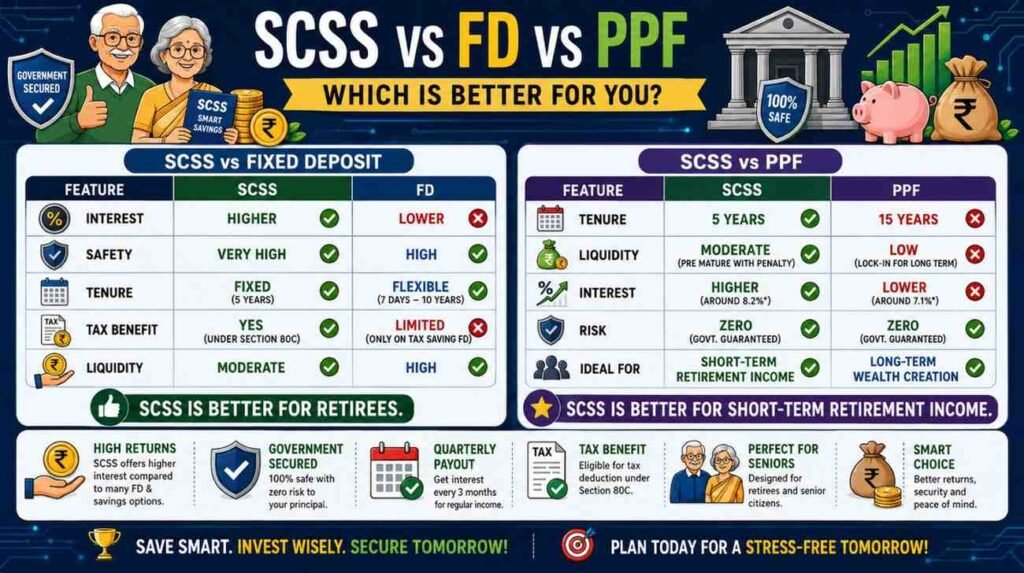
SCSS vs Fixed Deposit
| Feature | SCSS | FD |
| Interest | Higher | Lower |
| Safety | Very High | High |
| Tenure | Fixed | Flexible |
| Tax Benefit | Yes | Limited |
SCSS is better for retirees.
SCSS vs PPF
| Feature | SCSS | PPF |
| Tenure | 5 Years | 15 Years |
| Liquidity | Moderate | Low |
| Interest | Higher | Lower |
| Risk | Zero | Zero |
SCSS is better for short-term retirement income.
Who Should Invest in SCSS ?
Best for :
- Retired Individuals
- Risk averse investors
- People needing regular income
Not Ideal for :
- Young Investors
- High growth seekers
- Smart Investment Strategies :
Most People just invest – Smart people optimize
1. Combine with FD
Balance liquidity and returns

2. Spread Investments
Don’t put all money in one scheme
3. Use for Monthly Expenses
Treat it like pension
Common Mistakes to Avoid
Ignoring tax impact
Investing entire savings
Not comparing alternatives
Missing extension option
These mistakes reduce returns
Advanced Tips (Important) :
1. Ladder Strategy
Invest in Phases
2. Combine with Mututal Funds
Balance safety and growth
3. Reinvest Interest
Increase long term returns
Future of SCSS :
Interest rates depend on :
Inflation
Government Policies
Economic Conditions
SCSS will remain a top retirement scheme due to safety
FAQs (Frequently Asked Questions)
1. Is SCSS safe ?
Yes, It is Government Backed
2. Can i open multiple accounts ?
Yes, within limit
3. Can NRIs invest?
No
4. What happens after maturity ?
You can extend for 3 years
5. Is interest fixed ?
Yes, once invested
6. Can I withdraw anytime ?
Yes, with penalty
7. Is it better than FD ?
Usually yes
8. Can I invest jointly ?
Yes, with spouse.
9. What is SCSS interest rate in 2026?
The SCSS interest rate is 8.2% per year for FY 2026-27, with interest paid quarterly.
10. Who can Open SCSS Account ?
Generally, individuals aged 60 years or above can open an SCSS account, with specific provisions for certain retirees and eligible defence personnel.
Conclusion :
The Senior Citizen Savings Scheme is not just an investment – it is a financial safety net for retirement life
If you are someone who values :
- Stability
- Predictable Income
- Zero Risk
Then SCSS is one of the best option available in India
But here’s the actul truth – Don’t depend only on one scheme, smart financial planning means diversification. Think this once
Use SCSS as your foundation, not for your entire strategy.
Sources & References :-
- Department of Economics Affairs – Small Savings Schemes – Official interest rate notifications and current small savings information.
- Department of Economics Affairs – SCSS Interest Rate Notification – Official 2026 SCSS / small savings rate notification
- India Post – SCSS Scheme Information – Official SCSS eligibility, deposit limits and account information.
- Income Tax Department – Senior Citizens AY 2026-27 – current tax information, including Section 80TTB and the 50,000 deduction limit for eligible resident senior citizens.
- India Post – Senior Citizens Savings Scheme Rules – Official scheme rules covering maturity and premature closure provisions.
For More Updates Please Follow Click Here
Article was Last Updated On 21st August 2026.