


Inheritance Loans USA – How Estate Advance Loans Work and What Heirs Should Know in 2026
A strange thing happens after someone dies in America.
Family members may inherit money, property, or assets worth thousands of dollars, yet they still struggle to pay rent, funeral bills, mortgage payments, or legal costs for months.
Sometimes longer than a year
That’s because inheritance money usually gets trapped inside probate
Probate moves slowly. Courts move slowly. Paperwork moves slowly. Relatives arguing over estates move extremely slowly.
Meanwhile life keeps sending bills
That’s where inheritance loans enter the picture.
Companies in the U.S. now give heirs cash advances based on expected inheritances. Some people call them inheritance loans. Others call them probate advances or estate advances.
The idea sounds simple:
- You expect inheritance money later
- A company gives part of it upfront now
- The company gets rapid from the estate later
Simple concert. Expensive in some cases.
And many families don’t fully understand how these agreements work before signing them.
What are Inheritance Loans?
Inheritance loans are cash advances given to heirs waiting for probate distributions.
A company reviews the estate, estimates your future inheritance, then advances part of that amount before probate finishes.
Example:
- You expect to inherit $80000
- Probate may take 10 months
- An inheritance funding company advances $20000 now
- The company later collects repayment from estate proceeds
The money usually comes directly from the estate distribution once probate closes
Most inheritance advance companies avoid calling these products ‘loans’ because repayment often depends on estate recovery rather than traditional monthly payments.
Still, people search for ‘inheritance loans USA’ constantly because that’s the phrase most families understand.
Why Probate Takes So Long in the United States
Probate timelines vary widly by state.
Some estates close in 4 months. Others drag past 2 years.
Several things slow probate down:
- Court backlogs
- Missing paperwork
- Property disputes
- Unpaid taxes
- Debt claims
- Family disagreements
- Complex wills
- Multiple heirs
And real estate often slows everything further.
Selling a house inside probate can feel like trying to move furniture through wet cement.
Every step needs signatures, court approval, or attorney review.
Whey Heirs Look for Inheritance Advances
Most people seeking inheritance loans are under financial pressure.
Common situations include:
- Funeral expenses
- Credit card debt
- Mortgage bills
- Medical bills
- Job loss
- Emergency repairs
- Legal fees
A person technically inherit six figures while struggling to cover groceries during probate delays.
That situation frustrates families fast.
And grief makes financial stress worse because people already feel mentally exhausted.
Common Reasons Heirs Seek Inheritance Funding
| Financial Need | Why Heirs Use Inheritance Advances |
| Funeral Expenses | Immediate costs arise before inheritance arrives |
| Mortgage Payments | Helps prevent missed payments during probate |
| Medical Bills | Covers urgent healthcare expenses |
| Credit Card Debt | Provides temporary liquidity |
| Legal Fees | Assists with estate related legal costs |
| Emergency Repairs | Covers unexpected home or vehicle expenses |
| Job Loss | Helps maintain cash flow |
| Living Expenses | Supports household budgets during delays |
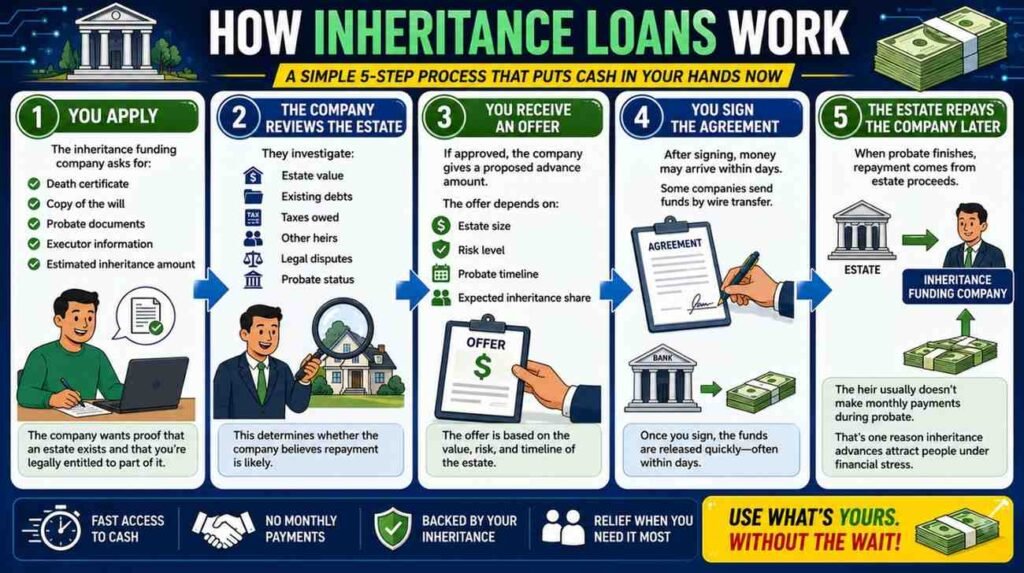
How Inheritance Loans Work
The process usually looks like this.
Step 1 : You Apply
The inheritance funding company asks for:
- Death certificate
- Copy of the will
- Probate documents
- Executor information
- Estimated inheritance amount
The company wants proof that an estate exists and that you’re legally entitled to part of it.
Step 2 : The Company Reviews the Estate
They investigage:
- Estate value
- Existing debts
- Taxes owed
- Other heirs
- Legal disputes
- Probate status
This determines whether the company believes repayment is likely.
Step 3 : You Receive an Offer
If approved, the company gives a proposed advance amount.
The offer depends on :
- Estate size
- Risk level
- Probate timeline
- Expected inheritance share
Step 4 : You Sign the Agreement
After signing, money may arrive within days.
Some companies send funds by wire transfer
Step 5 : The Estate Repays the Company Later
When probate finishes, repayment comes from estate proceeds.
The heir usually doesn’t make monthly payments during probate
That’s one reason inheritance advances attract people under financial stress.
Are Inheritance Loans the Same as Personal Loans?
No.
Traditional loans usually depend heavily on:
- Credit score
- Income
- Employment history
- Debt-to-income ratio
Inheritance funding companies care more about the estate itself.
Someone with terrible credit may still qualify if the estate has strong assets
That’s why inheritance advances appeal to people who can’t qualify for bank loans
How Much Money Can Heirs Receive?
Advance amounts vary heavily.
Some companies advance:
- $5000
- $20000
- $100000 or more
Most companies avoid the full inheritance amount because probate carries risk
If the estate loses value or legal disputes appear, repayment becomes complicated

Funding companies protect themselves by keeping financial cushion.
States Where Inheritance Advances are Common
Inheritance funding operates across much of the United States.
Large probate markets often include:
- California
- Florida
- Texas
- New York
- Illinois
Probate rules vary by state, so approval timelines and legal structures differ depending on local laws
Pros of Inheritance Loans
People use inheritance advances for real reasons.
And sometimes the timing genuinely matters.
Fast access to cash
Probate may take months or years.
Inheritance advances can arrive within days after approval.
That speed matters during emergencies.
No monthly payments during probate
Traditional loan payments create pressure immediately
Inheritance advances usually wait for estate settlement.
Credit scores often matter less
Someone dealing with poor credit or unstable employment may still qualify.
The estate matters more than income in many cases.
Families avoid selling assests quickly
Without cash pressure, heirs may avoid rushed property sales.
Forced quick sales often produce lower prices.
Risks and problems with inheritance loans
This part matters more than the advertisements.
Inheritance funding gets expensive fast.
Fees can be very high
Many heirs underestimate total repayment costs.
An advance company may provide:
- $20000 today
- Then collect $32000 later from the estate
People under stress focus on immediate relief and ignore long-term cost.
That’s understandable. Still dangerous.
Probate delays increase costs sometimes
Long probate timelines can increase total repayment depending on agreement structure
And probate delays happen constantly.
Especially when family conflict enters the picture.
One angry cousin can stretch probate like chewing gum.
Some Contracts Confuse People
Legal agreements in inheritance funding can become dense quickly.
People grieving a death are rarely in the best condition to analyze complicated financing contracts.
That creates risk
Heirs may receive Less Inheritance Later
The advance company gets paid first from assigned estate proceeds.
That reduces final inheritance distributions later.
Some heirs feel shocked months later when probate closes and remaining money looks smaller than expected.
How Inheritance Loan Companies make Decisions
Funding companies study estate risk aggressively.
Things that improve approval odds:
- Clear wills
- Large estates
- Real estate assets
- Few disputes
- Experienced probate attorneys
- Fewer debt claims
Things that create problems:
- Contested wills
- Heavy debt
- Tax problems
- Multiple lawsuits
- Unclear heirs
- Family conflict
Probate drama scares funding companies because drama delays repayment.
Common Alternatives to Inheritance Loans
Some families should compare alternatives before signing inheritance funding agreements.
Personal Loans
Traditional personal loans may cost less if you qualify
Especially for smaller emergency amounts.
Banks and lenders still care heavily about:
- Credit score
- Income
- Employment
But lower rates sometimes make personal loans cheaper overall.
Home Equity Loans
If you already own property, home equity financing may provide lower borrowing costs.
Still, your house becomes part of the risk equation
That matters.
Borrowing from Family
Not always realistic

Also not always emotionally healthy
Money inside grieving families can turn Thanksgiving into a legal thriller.
Executor Advances
Some executors distribute partial inheritances early when estate conditions allow.
This depends heavily on state law and estate stability
Who Usually Uses Inheritance Advances?
Inheritance funding customers often fall into a few groups:
- Families covering funeral costs
- Heirs facing foreclosure
- People dealing with medical debt
- Individuals waiting on large probate estates
- Beneficiaries needing quick liquidity
And many customers are middle-class families, not wealthy heirs from movies.
Probate delays hurt regular people hardest because they often lack emergency savings
How Long does Probate Usually Last?
Average probate timelines vary heavlily.
Simple estates may close within:
- 4 to 8 months
Complicated estates may last:
- 1 to 3 years
Real estate, business ownership, lawsuits, and family disputes extend timelines fast.
Probate courts already move slowly even before conflict appears.
Inheritance Funding vs Traditional Personal Loans
| Feature | Inheritance Funding | Personal Loan |
| Credit Score Requirement | Usually Less Important | Often Very Important |
| Monthly Payments | Typically No During Probate | Usually Required |
| Approval Focus | Estate Value & Inheritance Share | Income & Creditworthiness |
| Funding Speed | Often Within Days | Varies By Lender |
| Repayment Source | Estate Distribution | Borrower’s Income |
| Probate Dependency | Yes | No |
| Risk of Reduced Inheritance | Yes | No |
| Best For | Heirs Waiting On Probate | General Borrowing Needs |
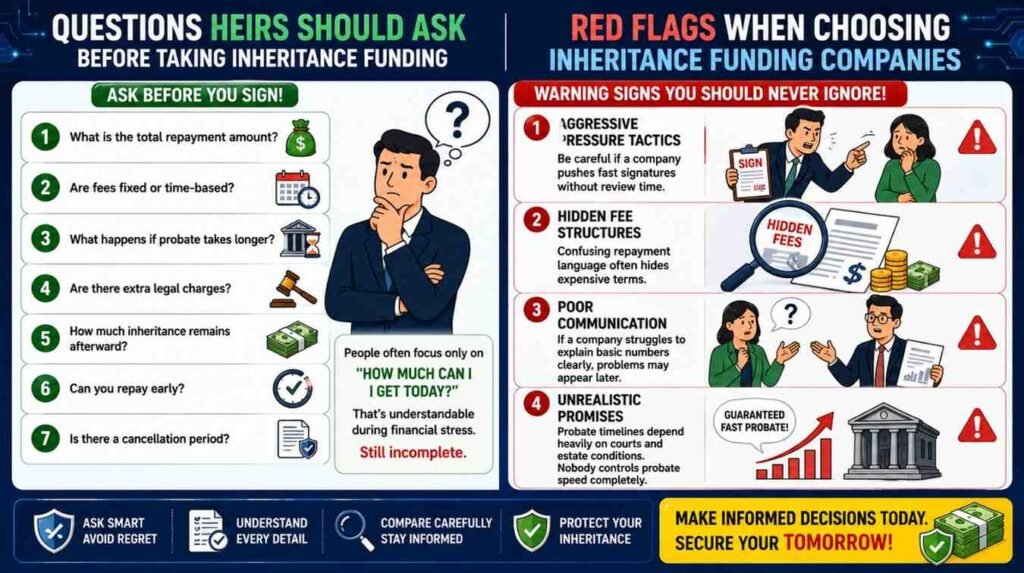
Questions Heirs should Ask before Taking Inheritance Funding
Before signing anything, ask:
- What is the total repayment amount?
- Are fees fixed or time-based?
- What happens if probate takes longer?
- Are there extra legal charges?
- How much inheritance remains afterward?
- Can you repay early?
- Is there a cancellation period?
People often focus only on ‘How much can i get today’?
That’s understandable during financial stress. Still incomplete.
Red Flags when Choosing Inheritance Funding Companies
Some warning signs deserve attention.
Aggressive Pressure Tactics
Be careful if a company pushes fast signatures without review time.
Hidden Fee Structures
Confusing repayment language often hides expensive terms.
Poor Communication
If a company struggles to explain basic numbers clearly, problems may appear later.
Unrealistic Promises
Probate timelines depend heavily on courts and estate conditions.
Nobody controls probate speed completely.
Best-Known Inheritance Funding Companies in the United States
Several Companies operate in this space, including:
- Inheritance Funding Company
- Probate Advance
- Peachtree Financial Solutions
- Approved Inheritance Cash
Terms, approval standards, and fees vary heavily between companies.
Comparing multiple offers matters here even more than regular lending.
Taxes and Inheritance Advances
Inheritance advances themselves generally aren’t taxed like income because they’re tied to expected inheritance proceeds
But estate taxes, inheritance taxes, and probate rules vary by state.
Large estates may involve additional tax planning concerns
Probate attorneys or tax professionals matter here because mistakes become expensive quickly
Should You Get an Inheritance Loan?
Depends entirely on the situation.
Fore some heirs:
- Immediate cash relief outweighs the cost
- Foreclosure or debt pressure creates urgency
- Probate delays create genuine hardship
For others:
- Waiting may save significant money
- Alternative financing may cost less
- Estate settlement may happen sooner than expected
People under stress often focus only on immediate survival. That’s human.
Still, inheritance funding agreements deserve slow reading and careful math before signing.
Especially during grief, when decision-making already feels foggy.
Final Thoughts on Inheritance Loans USA
Inheritance Advances exist because probate moves slowly and bills don’t.
That tension creates demand.
Some heirs use inheritance funding responsibly and feel relieved afterward. Others later realize they gave up far more inheritance money than expected.
So before signing:
- Read every fee carefully
- Compare multiple companies
- Ask direct questions
- Speak with a probate attorney if possible
- Calculate total repayment numbers fully
And don’t rush because someone says ‘limited-time approval’
Probate already creates enough stress without adding expensive surprises later.
Frequently Asked Questions (FAQs)
- What is an inheritance loan?
An inheritance loan often called an inheritance advance or probate advance, allows an heir to receive a portion of an expected inheritance before probate is completed. The funding company is repaid from the estate distribution later. - How long does probate usually take in the United States?
Probate timelines vary by state and estate complexity. Some estates settle within a few months, while others can take more than a year due to court schedules, disputes, taxes or property related issues. - Do inheritance loans require good credit?
Many inheritance funding companies focus more on the estate’s value and the heir’s expected share than on credit scores, making approval possible even for individuals with less than perfect credit. - How much money can i receive from an inheritance advance?
Funding amounts depend on factors such as estate value, probate status, outstanding debts, legal risks, and the size of your expected inheritance. - Are there monthly payments with inheritance funding?
Most inheritance advances do not require monthly payments during probate. Repayment is typically collected from estate proceeds once the inheritance is distributed. - What documents are required to apply for inheritance funding?
Companies commonly request probate filings, the will, executor information, a death certificate, and documents showing your expected inheritance interest. - Can inheritance funding help cover funeral expenses?
Yes, many heirs use inheritance advances to pay funeral costs, medical bills, mortgage payments, legal fees, and other urgent expenses while waiting for probate to finish. - What are the biggest risks of inheritance loans?
Potential risks include high fees, reduced final inheritance amounts, complicated agreements, and increased costs if probate lasts longer than expected. - Can probate disputes affect inheritance funding approval?
Yes contested wills, lawsuits, family disagreements, tax issues, and uncertain heirship can make approval more difficult because they increase estate risk. - Should I compare multiple inheritance funding companies?
Absolutely. Terms, fees, repayment structures and approval standards vary significantly between providers. Comparing offers can potentially save thousands of dollars.
Sources & References:-
- American Bar Association – Probate and Estate Administration Resources
- Internal Revenue Service (IRS) – Estate and Gift Tax Information
- Consumer Financial Protection Bureau (CFPB)
- National Conference of State Legislatures (NCSL) – Probate and Estate Laws
- USA Gov – Death and Estate Resources
- Legal Information Institute – Probate Law Overview
- Federal Trade Commission (FTC) Consumer Resources
- National Association of Estate Planners & Councils
- U.S. Courts – Probate and Court System Information
- National Academy of Elder Law Attorneys
Article was Last Updated on 26th June 2026.
For More Updates Please Follow Click Here