

Government Health Insurance Schemes in India – Complete Guide
Introduction :
Healthcare costs in India are rising faster than most people realize. A single hospitalization can wipe out years of savings. For middle class and low class income families, this is not just a financial burden, it can become a life altering crisis.
To address this, the Government of India has introduced multiple health insurance schemes aimed at providing affordable and accessible healthcare to citizens. Yet, many people either don’t know about these schemes or don’t fully understand how to use them.
This will break down everything you need to know about government health insurance schemes in India in a simple, practical and easy to understand way.
Why Government Health Insurance is Important ?
Let’s be honest – most people in India still depend on their savings for medical emergency.
That’s Risky
Here’s why Government Health Insurance Matters :
Medical Inflation is extreme high
Private Hospital costs are unaffordable for many
Emergency situations are Unpredictable
Many families fall into debt due to healthcare expenses.
Government Schemes act as a Financiay Safety Net, ensuring that people can access treatment without worrying about massive bills.
What is Government Health Insurance ?
Government Health Insurance refers to schemes launched by central or state governments to provide free or subsidized medical treatment to eligible citizens.
These Schemes typically cover :
Hospitalization Expenses
Surgeries
Pre and Post hospitalization costs
Sometimes even medicines and diagnostics
Unlike private insurance, these are often free or very low cost.
Major Government Health Insurance Schemes in India :
India has several schemes, but not all are equal. Some are nationwide, while others are state specific.
Let’s break down the most important notes
Ayushman Bharat Pradhan Mantri Jan Arogya Yojana (PM-JAY)
This is India’s flagship health insurance scheme.
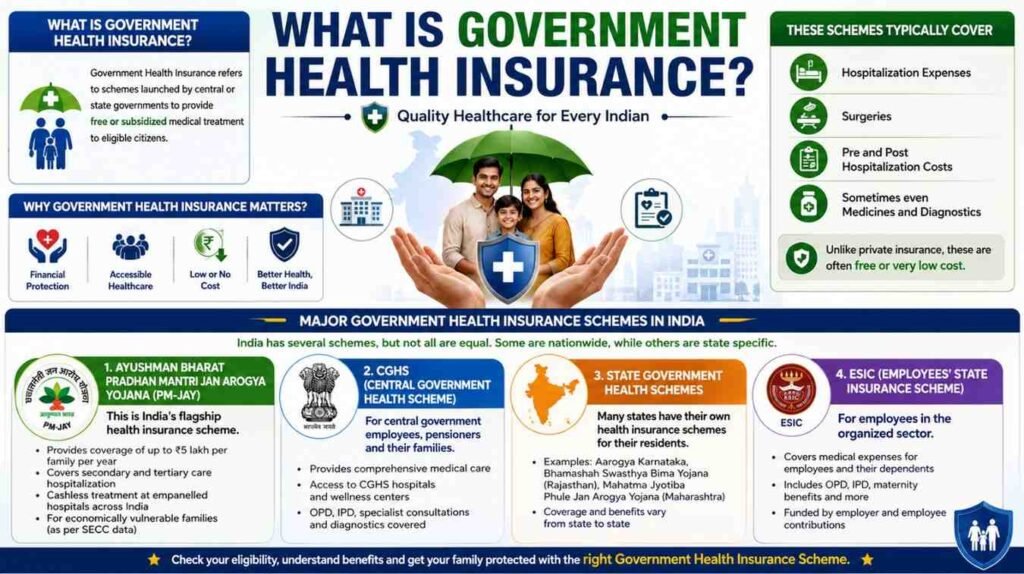
Ayushman Bharat Pradhan Mantri Jan Arogya Yojana Key Features :
Coverage up to 5 lakhs per family per year
Cashless treatment at empaneled hospitals
Covers secondary and teritary care
No restriction on family size.
Table 1 : Major Government Health Insurance Schemes in India
| Scheme | Mainly Designed For | Key Benefit | Coverage Type |
| Ayushman Bharat PM-JAY | Eligible beneficiaries | Cashless covered hospitalization | National |
| Aarogyasri | Eligible families | Major treatments and surgeries | State based |
| CMCHIS | Eligible Tamil Nadu families | Hospital treatments and procedures | Tamil Nadu |
| MJPJAY | Eligible Maharashtra beneficiaries | Hospitalization and specified procedures | Maharashtra |
| ESI Scheme | Eligible insured employees and families | Medical and hospitalization | Employment based |
| CGHS | Eligible Central Government beneficiaries | Medical and healthcare services | Government employees / pensioners and other eligible groups |
Who is Eligible for PM-JAY Scheme ?
Economically weaker sections
Families listed in SECC database
Rural and Urban Poor
Why it Matters ?
This Scheme alone has transformed healthcare access for millions.
State Government Health Insurance Schemes :
Many States run their own schemes alongside central programs
Aarogyasri Scheme (Andhra Pradesh & Telangana)
A Very Popular Scheme in South India
Features :
Covers major surgeries
Cashless treatment
Network of governement and private hospitals
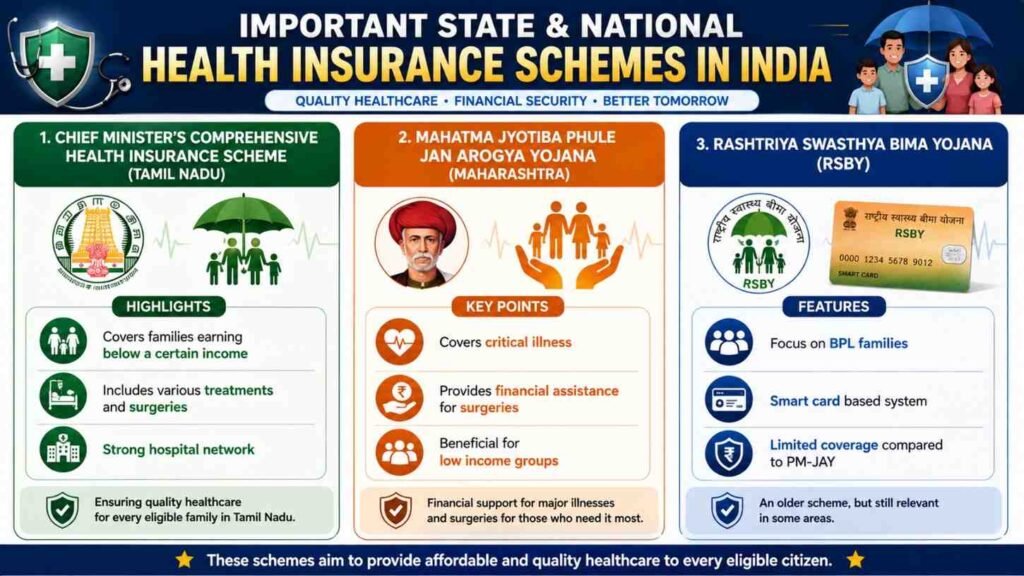
Chief Minister’s Comprehensive Health Insurance Scheme (Tamil Nadu)
Highlights :
Covers families earning below a certain income
Includes various treatments and surgeries
Strong hospital network
Mahatma Jyotiba Phule Jan Arogya Yojana (Maharashtra)
Key Points :
Covers critical illness
Provides financial assistance for surgeries
Beneficial for low income groups
Rashtriya Swasthya Bima Yojana (RSBY) :
An older scheme but still relevant in some areas.
Features :
Focus on BPL families
Smart card based system
Limited coverage compared to PM-JAY

Employees State Insurance Scheme (ESI) :
For salaried employees in certain sectors
Benefits :
Medical care for employees and their families
Covers hospitalization and treatment
Funded by employer and employee contributions
Central Government Health Scheme (CGHS)
For Central Government Employees and Pensioners
Features :
OPD and IPD services
Covers medicines and consultations
Wide hospital network
Benefits of Government Health Insurance Schemes :
These schemes offer multiple advantages
Financial Protection :
Reduces burden of medical expenses
Access to Healthcare :
Even rural populations get access to hospitals.
Cashless Treatment :
No need to arrange money immediately
Wide Coverage :
Many diseases and treatments covered
Eligibility Criteria Explined :
Each Scheme has different criteria, but common factors
Include :
Income Level
Occupation
Social Category
Residency
Important : Many eligible schemes people don’t apply simply because they don’t check eligibility.
How to Apply for Government Health Insurance :
The Process is simpler than most people think :
- Check Eligibility online or through local offices
- Gather required documents (Aadhar, Income Proof, Pan Card etc)
- Visit enrollment center or apply online
- Get health card or ID
- Use it at empaneled hospitals.
Documents Required :
Aadhar Card
Ration Card
Income Certificate
Address Proof
Passport Size Photos.
Table 2 : Government vs Private Health Insurance
| Feature | Government Health Insurance | Private Health Insurance |
| Cost | Usually free or subsidized for eligible beneficiaries | Premium paid by policyholder |
| Eligibility | Depends on scheme rules | Depends on policy and underwriting |
| Hospital Network | Empanelled hospitals | Insurer’s network hospitals |
| Cashless Treatment | Available for eligible covered treatment | Available subject to policy terms |
| Customization | Usually limited | More plan and add on options |
| Coverage | Scheme specific | Policy specific |
| Best For | Eligible families seeking affordable healthcare protection | People seeking broader or customized protection |
| Limitations | Eligibility, packages and network restrictions | Premiums, exclusions, waiting periods and policy conditions |
How to Use These Schemes :
Many people have the card but don’t know how to use it.
Here’s How :
Visit empaneled hospital
Show your card / ID
Hospital verifies eligibilty
Treatment is provided cashless
Common Mistakes People Make :
Not Checking Eligibility
You might already qualify but don’t know
Not Using Network Hospitals
Only Empaneled Hospitals are covered
Assuming Everything is Covered
Some Treatments may have limits
Ignoring Renewal (if applicable)
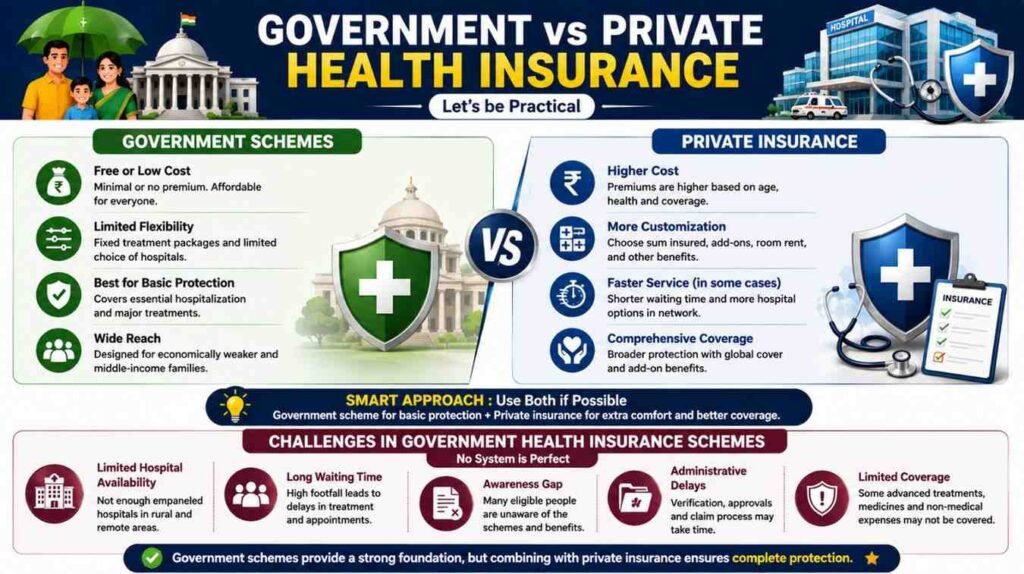
Government vs Private Health Insurance :
Let’s be Practical :
Government Schemes :
Free or Low Cost
Limited Flexibility
Best for Basic Protection

Private Insurance :
Higher Cost
More Customization
Faster service in some cases
Smart Approach : Use both if Possible
Challenges in Government Health Insurance Schemes :
No System is Perfect.
Some Common Issues :
Limited Hospital Availability in Rural Areas
Waiting Time
Awareness Gap
Administrative Delays
Tips to get Maximum Benefit :
Always carry your health card
Know your scheme details
Choose the right hospital
Keep documents ready
Stay informed about updates
Feature of Health Insurance in India :
India is rapidly improving healthcare infrastructure
We Can Expect :
More Digital Services
Better Coverage
Increased Awareness
Expnsion of Schemes
Frequently Asked Questions (FAQs) :
- Is Government Health Insurance Really Free ?
Most Schemes are free for eligible citizens
2. Can is Use it in Private Hospitals ?
Yes, but only empaneled hospitals
3. What is Maximum Coverage ?
Upto 5 lakhs in schemes like PM-JAY
4. Can Middle Class People Apply ?
Some Schemes are income based, others are employment based
5. Is it enough for all medical needs ?
Basic Coverage serious cases may need additional insurance.
6. What documents are needed for government health insurance?
Documents may include Aadhaar, ration card, income certificate, residence proof, or other scheme specific records. Requirements vary between schemes and states.
7. Does government health insurance cover the whole family ?
Many government schemes provide family based healthcare benefits, but the definition of eligible family members varies. Check the specific scheme rules before applying.
8. Is treatment completely cashless under government health schemes ?
Covered treatments can be cashless at eligible empanelled hospitals, subject to the scheme’s packages and conditions. Not every medicine, test, or procedure is automatically covered.
9. Does the ESI scheme cover family members ?
Eligible insured employees can receive medical benefits under ESI, and qualifying family members may also receive healthcare benefits according to ESIC rules.
10. Is government health insurance enough for all medical expenses ?
Not always. Government schemes can provide valuable protection, but coverage limits, eligible treatments, and hospital networks vary, so additional insurance may be useful for some families.
Sources and References :-
- Ayushman Bharat PM JAY official website – PM JAY eligibility, benefits, hospitals, and scheme information.
- Tamil Nadu CMCHIS official website – eligibility, scheme benefits, hospitals, and enrollment information
- Mahatma Jyotiba Phule Jan Arogya yojana – Official website – Maharashtra government health scheme information.
- Telangana Aarogyasri Health Care Trust – Aarogyasri eligibility, treatments, and hospital information.
- Employees State Insurance Corporation (ESIC) – ESI medical benefits and official scheme information.
- Central Government Health Scheme (CGHS) – official CGHS eligibility, healthcare facilities and beneficiary services.
Conclusion :
Government Health Insurance schemes in India are not just policies, they are lifelines for millions of families.
Ignoring them is a big mistake.
Understanding and using them properly can save you from financial disaster during medical emergencies
If you are eligible, don’t delay
If you are not, consider combining government and private insurance for complete protection
For More Updates Please Follow Click Here
Article was Last Updated on 8th August 2026.