


IRS Refund Status June 2026 – Why Some Taxpayers Are Still Waiting for Their Tax Refunds
Every Year Millions of Americans file their tax returns expecting a refund. For many households, that refund is more than just extra money. It helps cover bills, pay off debt, build savings, or handle unexpected expenses.
Yet one question continues to dominate online searches every tax season:
‘Where is My Refund’?
That question is especially common in June 2026.
While many taxpayers have already received their refunds, thousands are still checking their bank accounts, reviewing IRS (Internal Revenue Service) notices, and searching for updates on refund processing times. Some refunds are arriving later than expected, while others are undergoing additional review before payments can be released.
The good news is that a delayed refund does not automatically mean something is wrong.
In many cases, the IRS simply needs additional time to verify information, process documents, or complete routine checks before sending money to taxpayers.
Understanding how the refund process works can help reduce confusion and give taxpayers a clearer picture of what may be happening behind the scenes.
Why IRS Refund Status Searches are Rising in June 2026
Tax season officially ends long before every refund is issued.
Many taxpayers assume that filing a return automatically guarantees a quick payment. The reality is more complicated.
The IRS receives millions of returns within a short period. Each return passes through multiple verification systems designed to detect fraud, confirm taxpayer information, and ensure refund accuracy.
Most electronically filed returns with direct deposit information are processed quickly.
Others require additional attention.
That difference is one reason refund status searches continue to rise during June.
Taxpayers who expected a refund within a few weeks often become concerned with processing takes longer. As a result, searches related to IRS refund status, delayed tax refunds, and refund tracking increase significantly during this period.
How Long Does it Usually take to Receive a Refund?
The IRS generally states that most electronically filed returns with direct deposit are processed within 21 days.
However, that timeline is not a guarantee.
Several factors influence how quickly a refund can be approved and sent.
These Include:
- Filing method
- Direct deposit information
- Tax credits claimed
- Identity verification requirements
- Accuracy of return information
- IRS processing workload
A return that contains complete and accurate information usually moves through the system much faster than one requiring additional review.
The Biggest Reasons Refunds are Delayed
Refund delays happen for many reasons
Some are simple.
Others require more detailed review.
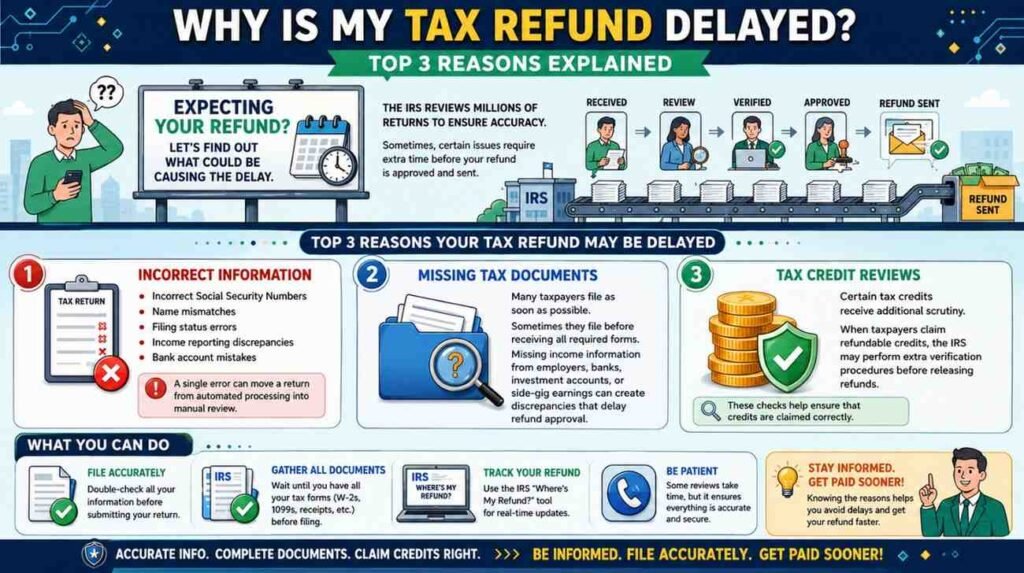
Identity Verification
Tax-related identity theft remains a major concern.
The IRS uses sophisticated systems to detect suspicious activity and prevent fraudulent refund claims.
If a return triggers verification procedures, processing many temporarily stop until the taxpayer confirms their identity.
While frustrating, these reviews help protect legitimate taxpayers from fraud.
Incorrect Information
Even small mistakes can slow processing
Common issues include:
- Incorrect Social Security Numbers
- Name mismatches
- Filing status errors
- Income reporting discrepancies
- Bank account mistakes
A single error can move a return from automated processing into manual review.
Most Common Reasons IRS Refunds are Delayed
| Reason for Delay | How it Affects Processing |
| Identity Verification Review | IRS must confirm taxpayer identity before releasing funds |
| Incorrect Personal Information | Return may require manual review |
| Missing Tax Documents | Income records must be verified |
| Refundable Tax Credit Review | Additional validation may be required |
| Banking Information Errors | Direct deposit cannot be completed |
| Amended Tax Return | Extra processing steps increase wait times |
| Paper Filing | Slower than electronic filing |
| High IRS Workload | Processing queues may become longer |
Missing Tax Documents
Many taxpayers file as soon as possible.
Sometimes they file before receiving all required forms.
Missing income information from employers, banks, investment accounts, or side-gig earnings can create discrepancies that delay refund approval.
Tax Credit Reviews
Certain tax credits receive additional scrutiny.
When taxpayers claim refundable credits, the IRS may perform extra verification procedures before releasing refunds.
These checks help ensure that credits are claimed correctly.
Whye some Taxpayers Receive Larger Refunds than Expected
A surprising number of taxpayers discover that their refunds are larger than anticipated.
This can happen for several reasons.
Over-withholding is one of the most common.
When employers withhold more federal income tax than necessary throughout the year, taxpayers may receive the excess amount back as part of their refund.
Tax credits can also increase refund amounts significantly
Education-related credits, family-related credits, and other eligible deductions can reduce tax liability and increase refund totals.
Some taxpayers may also receive adjustments after the IRS completes processing reviews.
These adjustments occasionally result in larger refund payments.
Direct Deposit vs Paper Check
The method chosen during filing affects delivery speed
Direct deposit remains the fastest and most reliable option
Funds move electronically from the Treasury Department to a taxpayer’s bank account.
Paper checks require several additional steps
They must be printed, processed, mailed, transported, and delivered.
Each step introduces potential delays.
For taxpayers still waiting in June, payment method can play a significant role in determining when money arrives.
Understanding the ‘Where’s my Refund’? Tool
One of the most useful resources available to taxpayers is the IRS refund tracking system.
The tool provides updates during different stages of processing.
Typically, refund status progresses through the phases:

- Return Received
- Refund Approved
- Refund Sent
Many taxpayers become concerned when status updates appear unchanged for several days.
That situation is often normal.
The system updates periodically, and processing activity may occur before visible status changes appear.
What happens when the IRS needs more Information?
Not every refund delay is caused by an error
Sometimes the IRS simply need clarification.
When additional information is required, taxpayers may receive a notice requesting documentation or verification. The notice typically explains what information is needed and how to respond.
Ignoring and IRS notice can extend processing times significantly.
Responding quickly usually helps move the return back into the processing queue faster.
Taxpayers should always read IRS correspondence carefully and verify that any communication comes from an official source.
Why June is Often a busy Month for Refund Processing
June sits in an interesting position on the tax calendar.
By this point, most early filers have already received refunds. At the same time, many returns filed closer to deadlines are still moving through the system.
Several groups commonly receive refunds during June:
- Taxpayers who filed near the April deadline
- Individuals who submitted corrected returns
- Taxpayers completing identity verification
- Paper filers
- Returns requiring manual review
- Refunds connected to additional documentation requests
This combination creates a noticeable increase in refund-related searches every June.
Many taxpayers assume they are the only ones waiting.
In reality, thousands of returns remain under review throughout the summer.
Amended Returns Usually Take Longer
Mistakes happen.
A taxpayer may forget income, miss a deduction, or discover new information after filing.
When corrections are necessary, an amended return can be submitted.
Amended returns generally require more processing time because they often involve manual review.
Unlike standard electronic returns, amended filings may pass through additional verification procedures before adjustments are approved.
As a result, taxpayers waiting on amended-return refunds frequently experience longer timelines.
Patience becomes especially important in these situations.
Common Myths about Delayed Tax Refunds
The internet is filled with refund rumors.
Some are harmless
Others create unnecessary panic.
Myth 1 : A Delayed Refund Means an Audit
A delay does not automatically indicate an audit.
Most delays involve routine verification procedures, document matching, or processing backlogs.
Myth 2 : Calling the IRS Speeds Up Processing
Many taxpayers believe calling repeatedly will accelerate a refund.
In most cases, customer service representatives cannot bypass standard processing procedures.
Myth 3 : Refund Delays Mean the Refund is Denied
A delayed refund and a denied refund are completely different situations.
Many delayed refunds are eventually approved and paid in full.
Myth 4 : Filing Earlier Guarantees Faster Payment
Early filing often helps, but it does not eliminate verification reviews.
Some early filers experience delays, while later filers receive refunds quickly
Every return follow its own path through the system.
How Direct Deposit can Reduce Refund Problems
Direct deposit remains one of the easiest ways to receive a refund.
Benefits Include:
- Faster delivery
- Reduced risk of lost checks
- Secure electronic transfer
- Easier tracking
- Fewer mailing issues
Taxpayers should always verify account and routing numbers before submitting returns.
A small banking error can create significant delays.
Many refund problems begin with incorrect deposit information.
Signs your Refund is still being Processed Normally
Waiting can be stressful.
Fortunately, several indicators suggest processing is continuing normally.
These Include:
- Refund status remains active in the tracking system
- No rejection notices have been received
- IRS requests have been answered
- Filing information was accurate
- Identity verification has been completed
In these situations, additional waiting is often the only requirement.
Processing times vary based on workload and individual return circumstances.
Financial Planning While Waiting for a Refund
Many households count on tax refunds to meet financial goals.
That expectation makes delays frustrating.
Still, financial experts often recommend avoiding plans that depend entirely on a refund arriving by a specific date.
Instead, taxpayers can use waiting periods to review budgets, reduce unnecessary spending, and prepare for eventual refund deposits.
When the refund arrives, having a plan helps ensure the money serves a meaningful purpose.

Common uses Include:
- Building emergency savings
- Paying off high-interest debt
- Covering medical expenses
- Funding education costs
- Strengthening household budgets
What Taxpayers should avoid Doing
Several mistakes can create additional complications.
Avoid these actions:
Filing a Second Return
Submitting another return because a refund appears delayed can create confusion and processing issues.
Providing Information to Scammers
Refund delays often attract scammers pretending to represent the IRS
The IRS does not typically initiate contact through unsolicited texts or social media messages requesting personal information.
Ignoring Official Notices
If the IRS requests information, delaying a response can extend refund processing times.
Constantly Changing Bank Information
Frequent changes can complicate payment delivery and verification procedures.
Fastest Ways to Avoid IRS Refund Delays
| Best Practice | Potential Benefit |
| File Electronically | Faster processing and fewer errors |
| Choose Direct Deposit | Quicker refund delivery |
| Verify Personal Information | Reduces manual review risk |
| Report All Income Correctly | Prevents income mismatches |
| Keep Tax Documents Organized | Improves filing accuracy |
| Respond Quickly to IRS Notices | Helps resume processing sooner |
| Review Banking Information Carefully | Avoids payment delivery issues |
| File an Accurate Return the First Time | Minimizes correction requests |
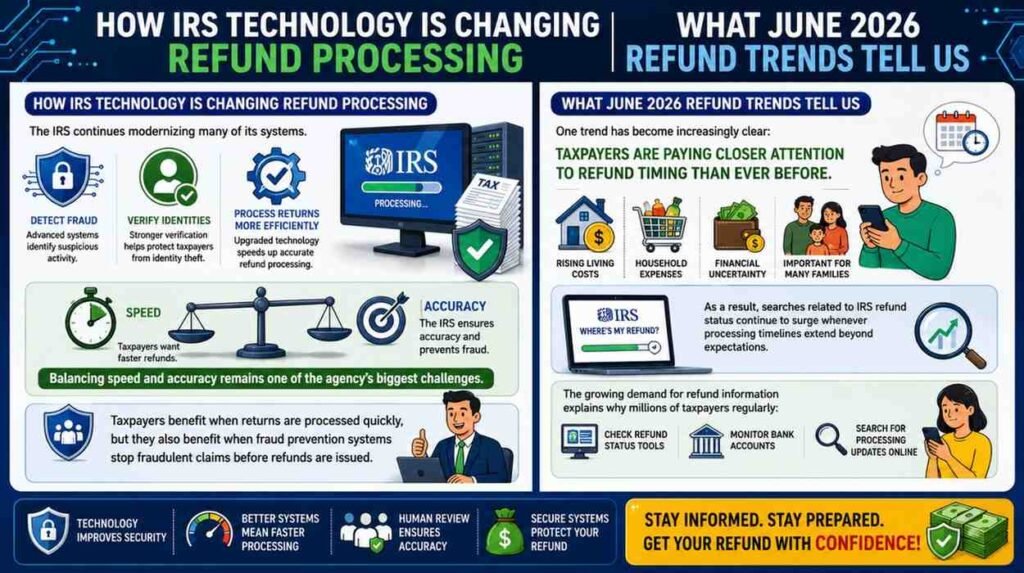
How IRS Technology is Changing Refund Processing
The IRS continues modernizing many of its systems.
Technology improvements help detect fraud, verify identities, and process returns more efficiently.
While modernization efforts improve security, some reviews still require human oversight.
Balancing speed and accuracy remains one of the agency’s biggest challenges.
Taxpayers benefit when returns are processed quickly, but they also benefit when fraud prevention systems stop fraudulent claims before refunds are issued.
What June 2026 Refund Trends tell Us
One trend has become increasingly clear
Taxpayers are paying closer attention to refund timing than ever before.
Rising living costs, household expenses, and financial uncertainty make refunds more important for many families.
As a result, searches related to IRS refund status continue to surge whenever processing timelines extend beyond expectations
The growing demand for refund information explains why millions of taxpayers regularly check refund status tools, monitor bank accounts, and search for processing updates online.
Frequently Asked Questions
- How long does an IRS refund usually take?
Most electronically filed returns with direct deposit are processed within approximately 21 days, although some returns require additional review.
2. Why is my refund still processing in June 2026?
Common reasons include identity verification, tax credit reviews, filing errors, income matching procedures, amended returns, or IRS workload backlogs.
3. Does a delayed refund mean there is a problem?
Not necessarily. Many delayed refunds are eventually approved after routine verification procedures are completed.
4. Can I Speed up my refund?
Taxpayers generally cannot accelerate standard IRS processing. Responding promptly to any IRS requests may help avoid additional delays.
5. Is direct deposit faster than a paper check?
Yes, Direct deposit remains the fastest refund delivery method available to most taxpayers.
6. How can I Check my IRS refund status?
Taxpayers can track their refund progress using the IRS. ‘Where is My Refund’? tool which typically shows whether a return has been received, approved, or sent.
7. Do tax credits affect refund processing times?
Certain refundable tax credits may receive additional verification before refunds are released, which can sometimes increase processing times.
8. Are paper filed tax returns slower than electronic returns?
Yes, Paper returns usually require additional handling and manual processing, making them slower than electronically filed returns.
9. What should I do if the IRS requests additional information?
Read the notice carefully, provide the requested documents promptly, and respond only through official IRS channels to avoid unnecessary delays.
10. Is direct deposit safer than receiving a paper refund check?
Direct deposit is generally considered faster, more secure, and less likely to experience delivery issues compared to mailed paper checks.
Final Thoughts
For taxpayers still waiting in June 2026, patience often becomes part of the process.
Most delayed refunds are connected to verification procedures, document reviews, tax credit checks, or routine processing requirements. While waiting ca feel frustrating, these safeguards help protect taxpayers and improve refund accuracy.
The best approach is simple.
Monitor your refund status regularly, respond quickly to any official IRS requests, keep records organized, and avoid common mistakes that can create additional delays.
For millions of Americans, refunds continue to move through the system every week. If your return was filed accurately and all required information has been provided, there is a strong chance your refund is simply working its way through the final stages of processing.
As June progresses, many taxpayers who have been checking their refund status for weeks may finally see the update they have been waiting for: Refund Approved.
Sources & References:-
- Official Governement Sources
- Supporting Financial Sources
- IRS Amended Return Information
- U.S. Department of the Treasury – Bereau of the Fiscal Service
- Government Accountability Office(GAO)
- Treasury Inspector General Tax Administration (TIGTA)
- National Taxpayer Advocate
- USA Govt – Tax Refund Information
Article was Last Updated on 26th June 2026.
For More Updates Please Follow Click Here