
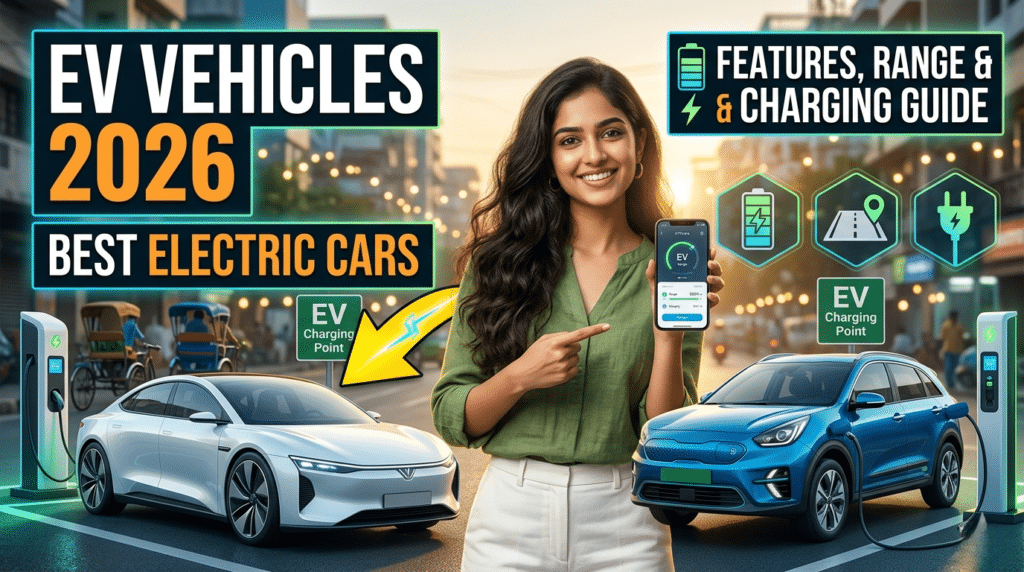
EV Vehicles 2026 – Best Electric Cars, Features, Range & Charging Guide
Electric Vehicles (EVs) : The Complete Beginners Guide (2026)
Introduction :
Electric Vehicles (RVs) are no longer just a trend – They are rapidly becoming a serious alternative to traditional petrol and diesel vehicles
But here’s the Reality :
Most people still don’t fully understand EVs. There is confusion, Myths and a lot of marketing noise
This Guide cuts through all that and explains everything in simple , practical language, so you can decide wether EVs actually make
sense for you
What are Electric Vehicles ?
Electirc Vehichles (EVs) are vehichles powered by electric motors instead of internal combustion engines.
Instead of burning fuel, they use stored electricity in batteries
Types of EVs :
Battery Electric Vehicles (BEVs – Fully Electric)
Hybrid Electric Vehicles (HEVs – Petrol + Electric)
Plug in Hybrid (PHEVs – Charge + Fuel Combo)
In India, BEVs are leading the markets right now.
Table 1 : EV vs Petrol Car : Practical Buyer Comparison 2026
| Factor | Electric Vehicle | Petrol Vehicle | Practical Verdict |
| Purchase Price | Often Higher Upfront | Often Lower | Petrol may Win Initially |
| Daily Running Cost | Usually Lower | Higher and fuel Dependent | EV advantage for frequent use |
| Routine Maintenance | Generally Lower | More Mechanical Service Items | EV advantage |
| Home Refueling / Charging | Very Convenient if Available | Not Possible | EV advantage with parking + charger |
| Long – Distance Flexibility | Requires Charging Planning | Fuel Stations Widely Available | Petrol advantage |
| Driving Experience | Quiet, Instant Torque | Engine / Gear Characteristics | Preference dependent |
| Battery / Fuel system concern | Battery Health and Warranty | Engine / Transmission Maintenance | Different risks |
| Urban Commuting | Strong Use Case | Convenient but Higher Fuel Expense | EV often attractive |
| Resale Predictability | Still Evolving | More Established Market | Petrol currently easier to estimate |
| Best Suited For | Predictable, Regular Usage | Flexible / Unpredictable Travel | Depends on lifestyle |
EV market growth in India :
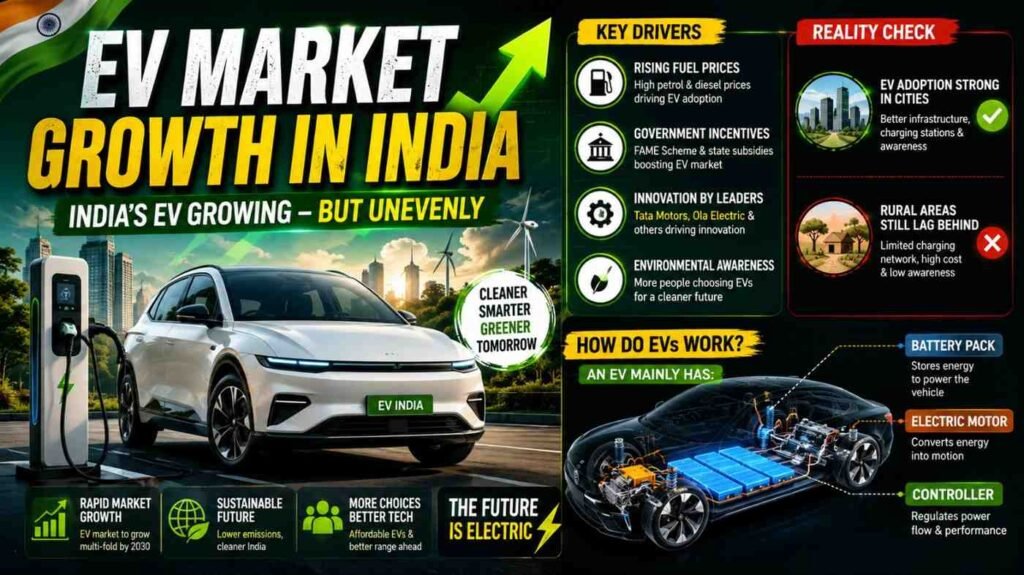
India’s EV growing – but unevenly
Key Drivers :
Rising Fuel Prices
Government Incentives (Fame Scheme)
Companies like Tata Motors, Ola Electric pushing innovation
Increased Environmental Awarnesses
Reality Check :
EV Adaption is Stroing in Cities
Rural Areas still lag behind
How do EVs work ?
An EV maily has :
Battery Pack
Electric Motor
Controller
Process :
- Battery stores electicity
- Controller regulates power
- Motor converts electricity in to movement
Simple, Fewer Parts, Less Maintenance
Cost of EVs vs Petrol Vehicles
Lets be Practical
Initial Cost :
EVs : Expensive
Petrol Vehicle :Cheaper
Running Cost :
EVs : 1 – 2 Km
Petrol : 8-10 Km
If you don’t drive much EV doesn’t make financial sense
Charging Infrastructure :
Charging is the biggest concern
Types :
Home charging
Public charging
Fast charging
Truth :
City uses = Manageable
Long – Distance uses still risky
EVs Beyond Cars (Scooters & Bikes)
EV Revolution in India is actually led by Two Wheelers
Popular Options :
Ola S1
Ather 450x
Tvs Iqube
For daily commuting, scooters are the smartest EV choice today
Maintenance of EVs :
EVs are simpler :
No :
Engine Oil
Clutch
Gearbox
Maintenance Includes :
Battery
Tyres
Software Updates
Lower longterm Cost
Battery Life & Replacement :
Key Facts :
Life span : 6-8 Years
Warranty : Upto 8 Years
Replacement Cost :
Expensive Today
Prices Expected to Drop
Biggest Risk factor for buyers
Environmental Impact :
EVs reduce emissions – but not fully clean
Why ?
India still use coal for electricity
Still better than petrol – diesel vehicles overall
Popular EV Cars in India :
Top EV Cars :
Tata Nexon EV
MGZSEV
Mahindra XUV 400 EV
Hyundai Kona Electric
Future of EVs in India :
Whats Coming :
Better Batteries
More Charging Stations
Affordable EVs
But full transtion will take time (5-10 years minimum)
Should you buy an EV ?
Buy EV if :
Daily City usage
Home charging Available
Longterm Savings Focus

Avoid EV if :
Frequent Long Trips
No charging access
Budget Constraints
Electric Vehicles (EVs) Advanced Insights, Real Life Use and Future Opportunities :
EV driving experience – what if actually feels like
People talk about cost and charging – but driving experience is where EVs quitely win
Instant Torque
The moment you pres the accelator :
No delay
No Gears Shifting
Immediate Pickup
In City traffic EV feels smoother than Petrol Cars
Silent Operation :
No Engine Noise
No vibration
Good for comfort – but also risky (pedestrians may not hear you)
Regenerative Breaking :
When you release the accelator :
Car slows down automatically
Energy goes back into battery
In heavy traffic, this becomes addictive
Apartment & Urban Living EV Challenges :
Most Indian Users Live in Apartments – This is where reality hits
Common Problems :
No dedicated parking
Society permission issues
Wiring complications
Meter sharing conflicts
Many people buy EV first, then struggle which charging later – wrong order
Practical Solution :
Confirm Charging setup before buying
Talk to society management
Check power load capacity
Weather Impact on EV Performance :
India’s climate is extreme – and EVs feel it
Summer Impact :
Battery Heatsup
Range Drops slightly
Cooling system consumes energy
Rainy Season :
No major issue
EVs are water proof (properly designed)
Biggest Issue – Heat, not Rain
Total Cost of Ownership (TCO – Long Term Reality)
Most people look only at price, smart buyers TCO
Example (5 years use)
Purchase Cost : EV – high & Petrol – Medium
Fuel Cost : EV – Very Low & Petrol – Very High
Maintenance : EV – Low & Petrol – Medium
Resale : EV – Uncertain & Petrol – Stable
If you sell early – EV losses value
If you use long term – EV wins.
Table 2 : EV Buying Checklist – 10 Questions Before You Pay
| Question | Green Signal | Warning Signal |
| Can I Charge at Home? | Dedicated reliable charger | No fixed charging option |
| Is parking permanent? | Dedicated parking | Parking changes frequently |
| Daily travel predictable? | Mostly fixed commute | Highly unpredictable travel |
| Enough real world range? | Large buffer over normal use | Regularly near maximum range |
| Public chargers nearby? | Multiple reliable alternatives | One charger dependency |
| Highway charging available? | Multiple stops / routes | Sparse charging route |
| Battery warranty strong? | Clear coverage and conditions | Unclear exclusions |
| Service centre nearby? | Accessible authorised service | Very distant support |
| Annual usage sufficient? | Regular / high kilometres | Very occasional driving |
| Keeping vehicle long term? | Longer ownership planned | Quick resale expected |
Public Charging Networks – Ground Reality :
On paper, charging network is growing fast
On ground :
Positives :
More charges in cities
Highway coverage improving
Problems :
Charges not working sometimes
Long waiting Times
Different charging standards
Don’t trust apps blindly – always have backup plan
EV Buying Checklist (Most Practical Section)
Before Buying EV ask yourself
Essential Questions :
Do i have home charging ?
My daily usage is how many kilometres ?
Do i travel long distance ?
Am i okay with planning trips ?
If your answers are weak :
Don’t buy EV at
This single check list can save you lakhs
EV Battery Technology – Simple Understanding :
Current Technology :
Lithium Ion Batteries
Future Technology :
Solid State Batteries (Faster Charging Safer)
But Reality :
Solid State is Still not Mass Available
EV Service & Repair ECO System :
Current Situation :
Limited Service Centres
Skilled Technicians Still Growing
Problem :
Small Cities – Service Difficulty
Spare Parts Availability Issues
Always check service support before buying EV brand
EV Insurance – Hidden Factor :
Most peopel Ignore This
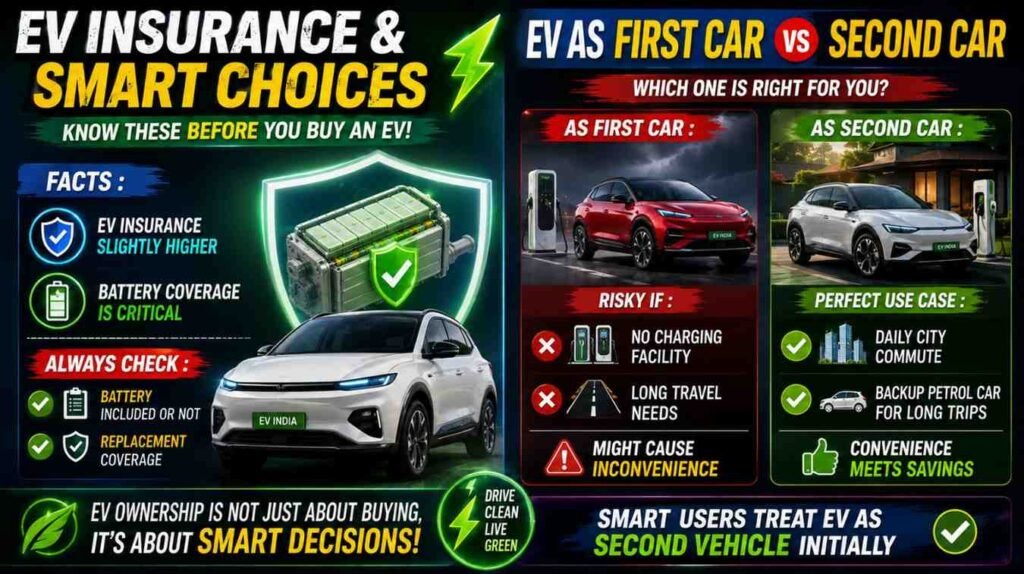
Facts :
EV Insurance Slightly Higher
Battery coverage is critical
Always Check :

Battery Included or Not
Replacement Coverage
EV as First Car vs Second Car :
As FIrst Car :
Risky if :
No charging
Long Travel needs
As Second Car :
Perfect use case :
Dialy city commute
Backup petrol car for long trips
Smart Users treat EV as second vehicle initially.
Depreciation of EVs :
This is still evolving
Why EV depreciates faster :
Battery aging fear
New technology coming fast
Buyers prefer new EV over used one
EV Business Opportunities in India :
This is where you should pay attention
Opportunities :
Charging Station Setup
EV Rental Business
Delivery fleet EVs
Content Blogging (Your Path)
EV Niche = Low Competition + Growing Demand
EV Market Trends (Next Five Years)
Expected :
EV prices will drop
Battery efficiency will improve
Charging network will expand
Not expected soon :
Petrol vehicles disappearing
EV becoming ultra cheap
Transition = Slow and steady
Biggest Myths about EV Vehicles :
Myth 1 : EV saves money immediately
Truth :
Takes time
Myth 2 : EV is completely pollution free
Truth :
Depends on electricity source
Myth 3 : EV has no maintenance
Truth :
Less, but not zero
When EV is a bad decision
Be honest – EV not for everyone
Avoid EV If :
You live in rural area
No charging access
You expect convenience like petrol
Wrong decision = frustration + loss
Longterm future – Realistic View :
What will happen :
EV adoption will increase
Hybrid vehicles will co exist
Infrastructure will improve slowly
No sudden revolution – gradual shift
FAQs about EV Vehicles :
- Are EVs Safe ?
Yes, modern EVs meet safely standards
- Can EVs be driven in Rain ?
Yes, completely safe
- How long does Charging take ?
6-10 Hours (home) 30-60 minutes fast charging
- Are EVs cheaper in the longrun ?
Yes, if used regularly
- Is EV maintenance costly ?
No, generally cheaper than petrol vehicles
- Can EV run without Battery ?
No – battery is core component
- Is EV good for daily 10 kms use ?
Not financially beneficial
- Can EV be charged daily ?
Yes no issues
- Does AC affect EV range ?
Yes, reduce range slightly
- Can EV be jump Started ?
No works differently than petrol cars
Final Extended Insight :
EV vehicles are not just about saving money – they require a change in thinking
If you :
Understand limitations
Adopt Usage
Think Longterm
EV becomes a powerful investment
If you :
Expect instant benefits
Ignore charging reality
EV becomes a burden
Conclusion :
EVs are not perfect – but they are the direction the world is moving toward
If you expect perfection, you will be disappointed somehow
If you understand the trade offs, EVs can save you money and future proof your mobility.
Sources & References :-
- PM E Drive – Official Government Portal – Current Scheme scope, eligible EV categories and incentives.
- PM E Drive Scheme Notifications – 2025-2026 amendments and extensions.
- PM E Drive Approved Models – model level eligibility and technical details.
- Bureau of Energy Efficiency EV Charging Guidance – home, public and DC fast charging fundamentals.
- Tata EV Battery Warranty Information – Useful current example showing why battery warranty assumptions need model specific verification.
- Tata Nexon EV Official Specifications – certified range, charging and real world range qualification.
For More Updates Please Follow Click Here
Article was Last Updated on 5 August 2026.