

Best EV Cars in India 2026 – Price, Range & Top Electric Cars List
Electric Cars in India : Complete Guide for Beginners (2026 Edition)
Introduction :
Electric Cars are More Longer Available in Future.
Which Rising Petrol Prices pollution Concerns and Government Support, more People are seriously considering switching to
Electric Vehicles (EVs). But lets be honest – still confusion.
Are EVs really worth it
What about charging ?
Are they affordable ?
Do they actually save money
This guide breaks everything down in simple terms – No technical Jargon, No Hype.
What is an Eelectri Car ?
An Electric Car (EV) runs on electricity instead of petrol or diesel.
Instead of :
Engine + Fuel Tank
You get :
Battery + Electric Motor
Types of Eelectric Vehicles in India :
- Battery Electric Vehicles (BEV) – Fully Eelectric (Most Common)
- Hybrid Vehicles – Petrol + Electric
- Plugin Hybrid (Phev-Charge+Fuel Combo)
In India BEVs are dominating right now ?
Growth of EV Cars in India :
India’s EV market is growing fast – but not evently
Why EVs are growing :
Petrol Prices Crossing Rs. 100 Per Litre
Goverment Subsidies (Fame Scheme)
Companies like Tata Motors Pushing Effordable EVs
Improved Charging Infrastructure
Reality Check :
EV adoption is still early stage, Tier – 1 Cities lead, Rural Areas ? not even close at
Are Electric Cars worth it in India ?
Lets not sugar coat it
Pros :
Fuel cost savings 1-2 per kmps (8-10 per km)
Low Maintenance
Silent Driving
Eco Friendly (Less Pollution)
Cons :
High Upfront Cost
Charging Infrastructure still limited
Battery Replacement is Expensive
Bottom Line
If You Drive daily in city RV = Smart Decision
If You Travel long distance often, Think Twice
Charing Infrastructure in India
This is the biggest concern for most buyers
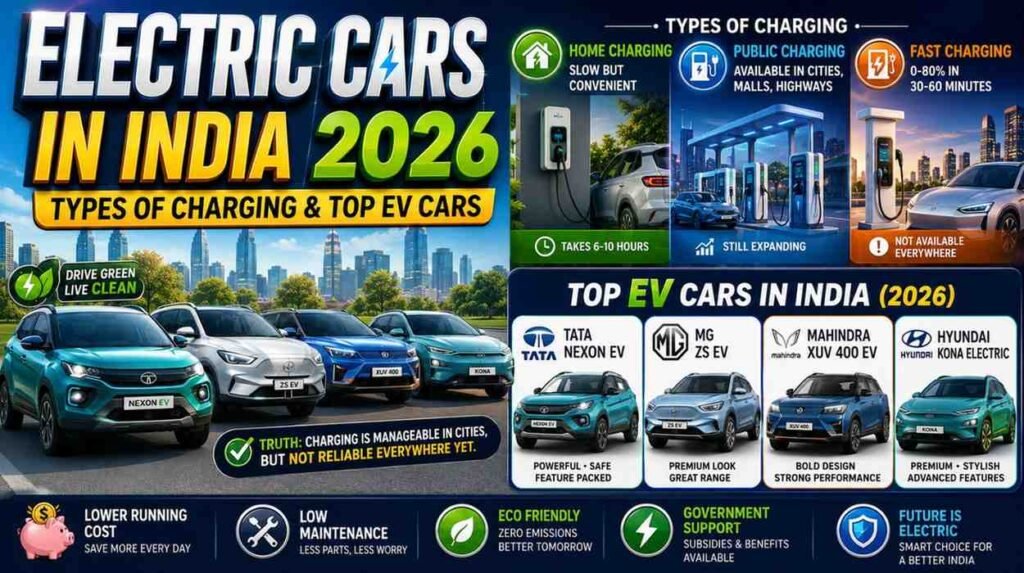
Types of Charging :
- Home Charging
Show but Convenient
Takes 6-10 Hours
- Public Charing
Available in Cities, Malls, Highways
Still Expanding
- Fast Charging
0-80 degress in 30-60 minutes
Not Available Everywhere
Truth :
Charging in Managerable in cities, but not reliable everywhere at.
Popular Electric Cars in India (2026) :
Top EV Cars :
Tata Nexon EV
MGZS EV
Mahindra XUV 400 EV
Hyundai Kona Electric.
Reality :
Tata Dominates budget EV market
Premium EV options still limited
Cost Comparison : EV vs Petrol Car
Lets break it simply :
Running Cost :
EV 1-2 rs per Km
Petrol Car – 8-10 rs per KM
Maintenance :
EV – Low
Petrol Car – High
Initial Cost :
EV – High
Petrol Car : Moderate.
Electric Car Buying Checklist (India 2026)
| Buying Factor | Why It Matters |
| Daily Driving Distance | Determines whether an EV provides long term savings |
| Home Charging Availability | Makes ownership easier and more convenient |
| Battery Warranty | Reduces future replacement concerns |
| Driving Range | Ensures it suits your travel requirements |
| Service Network | Provides easier maintenance and repairs |
| Total Ownership Cost | Helps calculate long term affordability |
Maintenance of Electric Cars :
EVs or Simpler Machines
No :
Engine Oil
Clutch
Gear Box Complicity
What You Maintain :
Battery Health
Tyres
Software Updates
Result :
Less Headache, Fewer Service Visits
Battery Life & Replacement :
Biggest fear : Battery Damage
Facts :
Battery lasts 6-8 years
Warrenty Usually 8 Years
Cost :
Replacement can cost 3-8 lakhs
But : Prices are dropping every year.
Environmental Impact :
EVs reduce pollution – but not completely clean
Why :
Electricity still comes from coal in India

Still better than petrol cars – Especially in cities
Should You Buy an EV ?
Lets be brutally honest
Buy EV if :
You Drive daily (office commute)
You live in a city :
You can charge at home
Avoid EV If :
You Travel Long Distance Frequently
No Charging Nearby
Budget is Tight
Future of EV Cars in India :
The future is electric – but slowly
Whats Coming :
More Affordable EVs
Battery Tech
More Charging Stations
Complaints like Tata Motors and others are investing heavily
But full EV dominance ? Stlll 5-10 Years away
Electric Cars in India – Advanced Guide, Hidden Truths and Practical Insights
Real world running cost breakdown (not just theory)
most articles over simplify EV savings. Lets breakit properly
Electricity Cost Reality :
In India :
Average Unit Cost : 6-10 per Unit
EV Efficiency : 6-8 Kms per Unit
So :
Cost Per Km = 1-1.5
Petrol Comparision
Petrol Price : 100 per Litre
Mileage : 15 Kmps per Litre
Cost per Kms = 6-8
Hidden Cost People Ignore
Charging Setup Cost : 20K-1Lakh
Time Cost (Waiting for Charging)
Battery Degradation Over Years
Yes EVs are Cheaper – But savings are not instant, they come over time
Smart Buyer Mistakes (Most People Get this Wrong)
This is where people loss money
Mistake 1 : Buying EV without Usage
If you drive :
Less than 20-30 Kms per day may not justify cost
Mistake 2 : Ignoring Charging Access
No home charging = Big problem
Public Charging Alone = Unreliable
Mistake 3 : Expecting Petrol car experience
EV = Petrol car you must adopt :
Plan Trips
Monitor Battery
If you don’t adjust mindset, you will regret the purchase
City vs Highway Usage – Brutal Reality :
City driving (Perfect for EV)
Frequent Braking – Regenerative Charging
Short Distances :
Easy home Charging
EV performs best here
Highway Driving (Problem Area)
Highspeed draings battery fast
Charging stations limited
Range anxiety kicks in
If you travel long distance, EV still has limitations
Battery Degradation – The Truth Nobody Tell Clearly
Battery doesn’t stay 100% forever
Real Degradation :
Year 1-2 : Minimal Drop
Year 3-5 : Noticable (10-15%)
Year 5-8 : Significant
What affects battery life :
Frequent fast charging
Extreme heat (Important in India)
Driving Habbits
Smart Usage = Longer Battery Life
Fast Charging vs Slow Charging – Which is Better ?
Fast Charging :
Quick (30-60min)
Damages Battery faster (Longterm)
Slow Charging :
Takes time (6-10 Hours)
Better for Battery Health
Best Strategy :
Daily – Slowcharge
Emergency – Fast Charge
Government Policies and Subsidies (Reality Check)
Benefits :
Subsidies under fame scheme
Road tax expceptions
Lower registration fees
Reality :
Subsidies reduce price – but don’t make EV cheap
Policies change frequently

Don’t depend only on subsidy for decision
Upcoming EV Cars in India (What to Watch) :
Upcoming Models Expected :
Tata Curw EV
Mahindra BE 05
New Budget EVs Under 10 Lakhs :
Market will become more competitive better choices
EV charging at home practical setup guide :
Most Imprtant Section – because this decides your experience
Requirements :
Dedicated Parking
Power Connection
Wall Charger Installation
Common Problems :
Apartment Restrictions
Powerload Issues
Cable Management
Without Home Charging EV Ownership becomes Stressful
Resale value of EV Cars :
This is still Uncertain
Current Situation :
EV Resale Market is Weak
Buyers worry about battery condition
Future :
As adoption grows – resale improves
If resale matters a lot to you EV is still risky
EV vs CNG vs Petrol – Practical Comparision
Running Cost : EV – Lowest & Petrol – High & CNG – Medium
Initial Cost : EV – High & Petrol – Medium & CNG – Medium
Convenience : EV – Medium & Petrol – High & CNG – Low
Infrastructure : EV – Growing & Petrol – Strong & CNG – Moderate
Actually No Perfect Option – It depends on your use case.
Who Should Buy and Electric Car?
| Buyer Profile | Recommendation |
| Daily Office Commuters | Highly Recommended |
| City Based Families | Excellent Choice |
| Long Distance Highway Travelers | Consider Carefully |
| Rural Area Residents | Check Charging Availability First |
| Buyers Looking for Lower Running Costs | Strong Recommendation |
| First Time Car Buyers | Suitable After Proper Research |
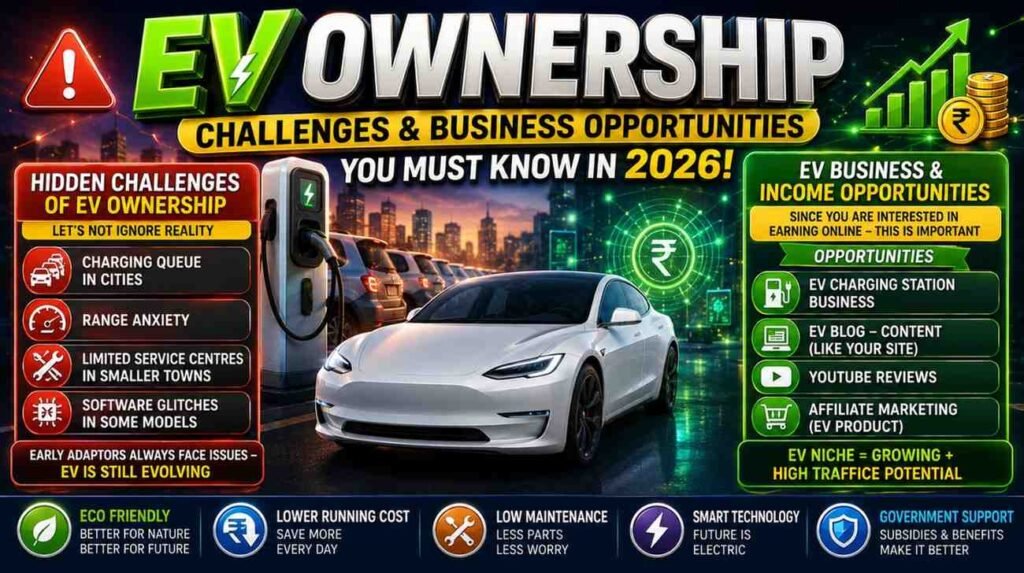
Hidden Challenges of EV Ownership :
Lets not ignore reality
Charging Queue in cities
Range anxiety
Limited Service Centres in Smaller Towns
Software Glitches in Some Models
Early Adaptors always face issues – EV is still evolving
EV Business & Income Opportunities :
Since you are interested in earning online – This is Important
Opportunities :
EV charging station business
EV blog – content (like your site)
Youtube Reviews
Affiliate Marketing (EV Product)
EV Niche = Growing + High Traffice Potential.
Physiological Shift Required for EV Users :
This is underrated
EV users must :
Plan Journeys
Monitor Charging
Adopt Driving Style
If you want just drive and forget EV may frustrate you
Long Term Future – What will Actually Happen ?
Realistic Expectations :
EV Adoption will grow steadily
Petrol Cars won’t disappear soon
Hybrid vehicles may dominate short term
Transition will be gradual – not sudden
FAQs about Electirc Cars in India :
- Are EVs worth buying in India in 2026?
Yes, electric cars are becoming a practical option for many Indian buyers. They offer significantly lower running costs, reduced maintenance, and a smoother driving experience. They are especially suitable for daily city commuting where charging facilities are easily available.
- Which is the best electric car for beginners in India ?
The best EV depends on your budget, driving habits, and charging availability. First time buyers should prioritize battery warranty, driving range, service network, and long term ownership costs instead of focusing only on the purchase price.
- How much does it cost to charge an electric car in India ?
Charging costs vary depending on electricity tariffs and battery size. In most Indian cities, charging an EV at home is generally much cheaper than refueling a petrol or diesel vehicle, making EVs more economical for regular use.
- Can I install an EV charger at home ?
Yes, Most electric cars support home charging. If you have dedicated parking and a suitable electrical connection, installing a home charger is straightforward and provides the most convenient charging experience.
- How long does an EV car battery last ?
Most modern EV batteries are designed to last between 6 and 8 years or even longer under normal driving conditions. Manufacturers also provide battery warranties, giving buyers additional peace of mind.
- Is EV good for village Usage ?
Not ideal yet due to charging limitations
- Can EV Batteries Catch Fire ?
Rare, but possible – mostly due to defects
- Do EVs loss range in Summer ?
Yes, Extreme heat affects battery performance
- Is EV good as second car ?
Perfect Use case
- What should I check before buying an electric vehicle ?
Before purchasing an EV, evaluate your daily driving distance, charging accessibility, battery warranty, nearby service centers, expected ownership costs, resale value, and available government incentives.
Final Thoughts :
Electric Cars in India are not perfect – But they are improving fast.
If you expect :
Cheap + Long range + Fast Charging + Low Price
You will be Disappointed
But if you want :
Low Running Cost
Smooth Driving
Future Ready Vrehicle
Then EV is a smart move
Final Conclusion (Extended Insight) :
Electric Cars in India are a Smart, But sitauational decision
Not buying EV today won’t make you outdated
Not understanding EV properly before buying will cost you money
The smartest Approach :
Understand you usage
Evaluate Charging Access
Think Longterm
Then Decide.
Sources & References
- Ministry of Road Transport an Highways (MoRTH), Government of India
- Ministry of Heavy Industries, Government of India (FAME India Scheme)
- NITI Aayog – Electronic Mobility Reports
- Bureau of Energy Efficiency (BEE)
- Society of Indian Automobile Manufacturers (SIAM)
- Vahan Portal – Government of India
- Tata Motors Electric Mobility
- Mahindra Electric Automobile Division
- MG Motor India Electric Vehicles
- Hyundai Motor India Electric Vehicle Information
For More Updates Please Follow Click Here
Article was Last Updated On 21st July 2026.