


Mutual Funds for Beginners in India (2026) – Start with ₹100 & Build Lakhs Even if You’re a Complete Beginner
Introduction :
Let’s be honest
Most People in India want to invest, but they get stuck the same point.
Stock Market will be Risky
What will happen if we lose money ?
Where to Start ?
Tha’ts exactly where mutual funds come in.
They are not magic. They won’t make you rich overnight.
But if used correctly, they can slowly build serious health – even if you start with 100 rupees also
This Guide is built for one type of person
Someone who knows nothing about investing but wants to start smart.
No jargon, No confusion, Just clarity
What is a Mutual Fund ?
A Mutual Fund is simple :
Many people pool money
A professional fund manager invests it
You get returns based on performance
Think of it like this :
You don’t know cricket well
You hire a professiona player to paly for you
You share the winnings
That’s the actual meaning of Mutual Fund
Example : (Very Simple)
1000 people invest 1,000 each
Total – 1,00,000
Fund Manager invests in stocks
If value becomes 12,00,000 – You get Profit
Why Mutual Funds are better for Beginners :
1. Low Starting Amount
Start with 100-150 (SIP)
2. Professional Management
Experts handle investments
3. Diversification
Money spread across multiple stocks – lower risk
4. Compounding Power
Your money earns returns on returns
Types of Mututal Funds (Simple Breakdown)
1. Equity Funds
Invest in Stocks
High Risk, High Return
2. Debt Funds
Invest in Bonds
Low risk, stable returns
3. Hybrid Funds
Mix of Equity + Debt
4. ELSS Funds
Tax Saving (Section 80C)
What is SIP (Systematic Investment Plan) :
SIP means :
Invest small amount every month
Example :
1000 per month
10 years
You build big corpus slowly
Why SIP is Powerful ?
Reduces Risk
Build Discipline
Uses market ups & downs
How much You can Earn ?
Let’s be Realistic :
FD – 6-7%
Mutual Funds = 10-15% (long term)
Example :
5000 per month SIP
15 years
12% return
25,00,000
How to Start Mutual Funds in India :
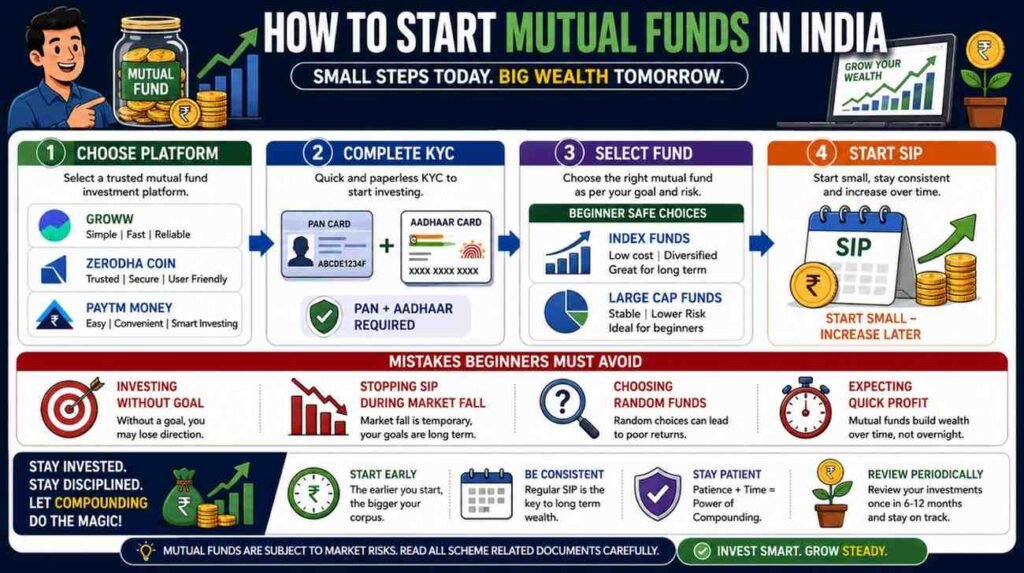
Step : 1 Choose Platform
Groww
Zerodha Coin
Paytm Money
Step : 2 Complete KYC
Pan + Aadhar Required
Step : 3 Select Fund
Beginner Safe Choice
Index Funds
Large Cap Funds
Step : 4 Start SIP
Start small – Increase later
Mistakes Beginners Must Avoid :
Investing without goal
Stopping SIP during market fall
Choosing random funds
Expecting quick profit
Best Mutual Funds for Beginners (Category Wise) :
Large Cap Funds – Stable
Index Funds – Low Cost
Hybrid Funds – Balanced
Risk in Mutual Funds (Truth) :
Mutual Funds are not risk free
Market Falls = Temporary Loss
But :
Long term = Growth
Mutual Funds vs FD :
| Feature | Mutual Fund | FD |
| Risk | Medium | Low |
| Return | High | Low |
| Flexibility | High | Low |
Is Mutual Fund Safe in India ?
Yes – regulated by Securities and Exchange Board of India
Best Time to Invest ?
Don’t Wait
Star Now
Time > Timing
Pro Tips (Most Important Section) :
Start Early
Stay Consistent
Increast SIP yearly
Ignore short term noise
Advanced Mutual Fund Strategies for Beginners (2026) :
1. Global Based Investing (Most Ignored but Most Powerful) :
Most Beginners start like this :
Will Invest, Lets see what happens
Tha’s a Mistake :
Instead, every investment should have a clear goal.
Child Education = 10-15 Years
House = 5-10 Years

Retirement = 20 Years
Why this Matters :
When you Invest Without a Goal :
You panic during market falls
You withdraw early
You lose compounding benefits
But with Goals :
You stay disciplined
You choose the right fund type
You track progress properly
2. Asset Allocations (Real Secret Behind Wealth Creation)
Most People Think :
Will Select Best Mututal Fund Only
That’s Wrong :
Real wealth comes from asset allocation, not fund selection
Example :
70% Equity Funds
20% Debt Funds
10% Gold
This Balance :
Reduces Risk
Improves Stability
Gives Consistent Returns
Beginner Allocation Strategy :
| Age | Equity | Debt |
| 20-30 | 80% | 20% |
| 30-40 | 70% | 30% |
| 40-50 | 60% | 40% |
Younger = More Risk
Older = More Safety
Market Volatility – How to Handle Fear :
This is where more beginners fail
When Market Falls :
News channels panic
Social Media Romorus Spread
People Stop SIP
This is the Biggest Mistake :
Reality :
Market Fall – Discount Sale
If you contiune SIP :
You buy at lower price
You get more units
Your future returns increase
This concept is called rupee cost averaging
4. Understanding NAV (Net Asset Value) :
Many Beginners Think :
Low NAV Funds Better
This is Completely Wrong
What is NAV (Net Asset Value) ?
NAV = Price of one unit of mutual fund
Important Truth :
10 Rupee NAV fund = Cheap
100 Rupee NAV fund = Expensive
Returns depend on performance, not NAV
5. Expense Ratio – Silent Money Killer
Every Mutual Fund charges a small fee
This is called Expense Ratio
Why it Matters :
Even 1% difference
Can reduce lakhs over long term
Example :
Fund A – 1% Expense
Fund B – 2% Expense
After 20 Years :
Huge Difference in returns
Smart Tip :
Prefer :
Index Funds (Low Cost)
Direct Plans
6. Direct vs Regular Mutual Funds
This is something agents won’t tell you.
Direct Plan :
No Middleman
Higher Returns
Regular Plan :
Commission Included
Lower Returns
Same Fund
Same Ratio
But :
Direct = More Profit fo You
7. How to Select the Right Mutual Fund
Don’t randomly pick funds
Use this checklist :
1. Past Performance (Consistency, Not just High Returns)
Check 5-10 Years
Avoid short term top performers
2. Fund Manager Experience
Experienced Manager = Better Decisions
3. AUM (Assets Under Management)
Too Small = Risky
Too Large = Slow Growth
4. Expense Ratio
Lower is Better
8. Active vs Passive Funds :
Active Funds :
Managed by Experts
Higher Fees
Passive Funds :
Follow market index (like Nifty 50)
Lower Cost
For Beginners :
Index Funds are best starting point
9. SIP vs Lumbp Sum – Which is Better ?
SIP :
Monthly Investment
Safer
Best for Beginners
Lum Sum :
Invest big amount at once
Risky if market high
Smart Strategy :
Beginners – SIP
Experts – Combination
10. When Should You Review Your Iinvestments ?
Don’t check daily :

That’s Emotional Investing
Ideal Review Time :
Every 6 Months
Once a Year
Check :
Is fund performing well ?
Is it matching your goal ?
11. Over – Diversification – Hidden Mistake:
Many Beginners do this :
10-15 mutual funds
This is not smart
Problem :
Hard to Track
Duplicate Investments
Lower Returns
Ideal Number :
3 to 5 funds are enough

12. Power of Increasing SIP (Step-Up Strategy) :
Most People invest same amount forever
Big Mistake
Smart Move :
Increase SIP Every Year
Example :
Year 1 -1000
Year 2 – 1500
Year 3 – 2000
This is Dramatically Increases Wealth
13. Realistic Return Expectations :
Don’t believe fake promises :
Double the Money Fast
Reality :
Equity Funds – 10-15%
Debt Funds – 6-8%
Consistency matters more than high returns
14. Taxation on Mutural Funds (India) :
Equity Funds :
Short term (<1 Year) – 15% Tax
Long term (<1 Year) – 10% Tax
Debt Funds :
Taxed as per Income Slab
Always consider post tax returns
15. Emergency Fund Before Investing :
This is Critical
Before Investing :
Keep 3-6 Months Expenses in :
Savings Account
Liquid Funds
Without This :
You may break investments early
16. When NOT to Invest in Mutual Funds :
Don’t Invest If :
You need money in < 1 Year
You panic easily
You don’t understand basics
Mutual Funds need Patience.
17. Psychology of Successful Investors :
This is the real difference
Successful Investors :
Stay calm during crash
Continue SIP
Think long term
Failed Investors :
Panic well
Stop Investing
Chase trends
Mindset > Strategy
18. Long-Term Wealth
If you follow :
SIP discipline
Long term patience
Smart allocation
You don’t need luck
You don’t need stock picking
You don’t need timing
You just need :
Consistency
This extension alone will :
Increase your article depth
Improve Google ranking signals
Reduce bounce rate
Build trust with readers
Top 10 FAQs – Mutual Funds for Beginners
1. What is minimum amount required to start mutual funds in India ?
You can start with as low as 100 rs throung SIP in many mutual fund platforms. This makes it easy even for beginners with limited income.
2. Are mutual funds sare for beginners ?
Mutual funds are relatively safe when compared to direct stock investing because they are diversified and managed by professionals. They are regulated by Securities and Exchange Board of India. But they still carry market risk.
3. What is the best type of mutual fund for beginners ?
For beginners, index funds, large cap funds, and hybrid funds are considered safer and more stable compared to small cap or sector funds
4. Can i lose money in mutual funds ?
Yes, mutual funds are linked to market performance, so short term losses are possible. However, long term investing reduces risk significally
5. What is SIP and why is it recommended ?
SIP (Systematic Investment Plan) allows you to invest a fixed amount regularly. It helps reduce risk, build discipline, and take advantage of market fluctuations
6. How long should i invest in mutual funds ?
For best results, you should stay invested for a least 5 to 10 years, especially in equity mutual funds.
7. Which app is best for mutual fund investment in India ?
Popular beginner friendly apps include Groww, Zerodha Coin, Paytm Money. They offer easy interface and direct plan options.
8. Is mutual fund investment better than fixed deposits ?
Mutual Funds generally offer higher returns than FDs in the long term, but they also come with higher risk. FDs are safer but give lower returns.
9. Can I withdraw my mutual fund anytime ?
Yes, most mutual funds allow withdrawl any time. However, ELSS funds have a lock in period of 3 Years.
10. Do I need a lot of Knowledge to start mutual funds ?
No, you just need basic understanding and can start with simple funds like index funds. Learning gradually is enough
Powerful Conclusion (Mutual Funds for Beginners) :
Mutual Funds are not just an investment option – they are a financial habit that can transform your future if used correctly. The bigger advantage is not how much you invest, but how consistently you stay invested. Even small amounts, when combined with time and discipline, can grow into singificant wealth.
For beginners in India, mutual funds offer the perfect balance between growth, flexibility, and accessibility. You don’t need to be an expert, you don’t need huge capital, and you don’t need to time the market perfectly. What you really need is patience, consistency, and the right mindset.
If you start today, stay invested for the long term, and avoid common mistakes, mutual funds can help you move from financial stress to financial stability – and eventually to financial freedom.
Sources & References :-
- SEBI – Securities and Exchange Board of India
Official Source for mutual fund regulations, investor protection, risk disclosures and the regulatory framework. - AMFI – Introduction to Mutual Funds
Explains what mutual funds are, how they work, professional fund management, diversification, and basic concepts for beginners. - AMFI – Investor Education Centre
Covers mutual fund types, SIPs, KYC, investment risks, benefits and other important investor basics. - AMFI – How to Invest in Mutual Funds
Provides Information about KYC requirements, investment methods, direct investing, and investing through mutual fund distributors. - AMFI – Direct Plan vs Regular Plan
Useful reference for understanding the difference between Direct and Regular mutual fund plans and their expense structures. - AMFI – Mutual Funds Scheme Categorisation
Reference for equity, debt, hybrid, solution oriented schemes, index funds, ETFs and other mutual fund categories.
For More Updtes Please Follow Click Here
Article was Last Updated on 21st August 2026.