


Finance Paint – Smart Budgeting, Investing, and Money Planning Guide for 2026
Finance Paint
Money Problems usually start with confusion.
People work hard, earn decent salaries, and still feel broke by the end of the month. Bills stack up. Credit card balance grow. Savings stay close to zero. Then one emergency shows up and everything falls apart.
That’s where Finance Paint comes in.
Think of finance paint like a layer that covers financial chaos. Tyou slowly build habits, structure, and awareness until your money life actually looks clean and controlled. Same way paint changes a plain wall, smart financial planning changes how your future looks.
And honestly, most people in the USA need this badly right now.
Housing costs are high. Groceries are expensive. Student loans still hit millions of Americans every month. Car insurance keeps rising. A lot of families earn good income on paper but still ive paycheck to paychek.
So this guide breaks everything down in simple language. No finance degree needed. No complicated Wall Street Jargon.
Just practical stuff that actually matters.
Why finance paint matters in 2026
The average American household spends thousands every month on things they barely track.
Streaming subscriptions. Food delivery. High interest debt. Buy now pay later apps. Random online shopping at 1AM because Instagram ads somehow know your weaknesses better than your ralatives do.
Small leaks become giant financial holes.
Finance paint is about fixing those leaks before they destroy your long-term goals.
And the timing matters.
Interest rates have changed how borrowing works. Credit card debt inn the US crossed historic levels recently. Many people now carry balances month after month instead of paying them fully.
That means banks make money while consumers stya stuck.
You need systems
Not motivation. Systems.
Start with Real Monthly Budget
Most budgeting advice online feels robotic
People tell you to stop buying coffee like a $6 latte caused a national debt crisis
Real budgeting is different
You need a system you can actually follow for years
Here’s a simple monthly breakdown many Americans use :
| Category | Suggested Percentage |
| Housing | 25% to 35% |
| Food | 10% to 15% |
| Transportation | 10% |
| Savings | 15% to 20% |
| Debt Payments | 10% to 20% |
| Entertainment | 5% to 10% |
This won’t fit every person perfectly. A software engineer in California and truck driver in Texas live very different financial lives
Still, the structure helps
The biggest mistake people make is spending first and saving later
Later never comes
Emergency funds save people from disaster
An emergency fund sounds boring until your car dies on a highway or your company suddenly cuts jobs.
Then it becomes the most beautiful bank account you’re ever seen.
A lot of Americans stil don’t have enough savings to cover 3 months of expenses. That’s dangerous
You don’t need $50000 immediately
Start with :
- $500
- Then $1000
- Then 1 month of expenses
- Then 3 to 6 months
That progression workd
Keep the money somewhere accessible but separate from daily spending. High yield savings accounts are popular because they usually pay better pay interest than traditional bank accounts.
And no, your emergency fund is not for Black Friday shopping.
Credit Scores quietly control your life
People underestimate credit scores until they try to :
- Buy a house
- Finance a car
- Rent an apartment
- Get approved for certain jobs
- Apply for premium credit cards
Then suddenly the number matters.
In the USA scores usually range from 300 to 850
Anything above 740 is generally considered strong
Here’s what affects your score most :
Payment History
Pay bills on time
Simple advice. Huge impact
Late payments stay on reports for years
Credit Utilization
If your credit card limit is $10000 and you use $9000 regularly, lenders get nervous.
Keeping usage below 30% helps. Lower is even better.
Credit Age
Older accounts help because they show long term financial behavior
Closing old cards sometimes hurts people without them realize why.
Hard Inquiries
Applying for too many loans or cards quickly can reduce scores temporarily
One or two checks usually aren’t catastrophic. Ten applications in a month looks messy.
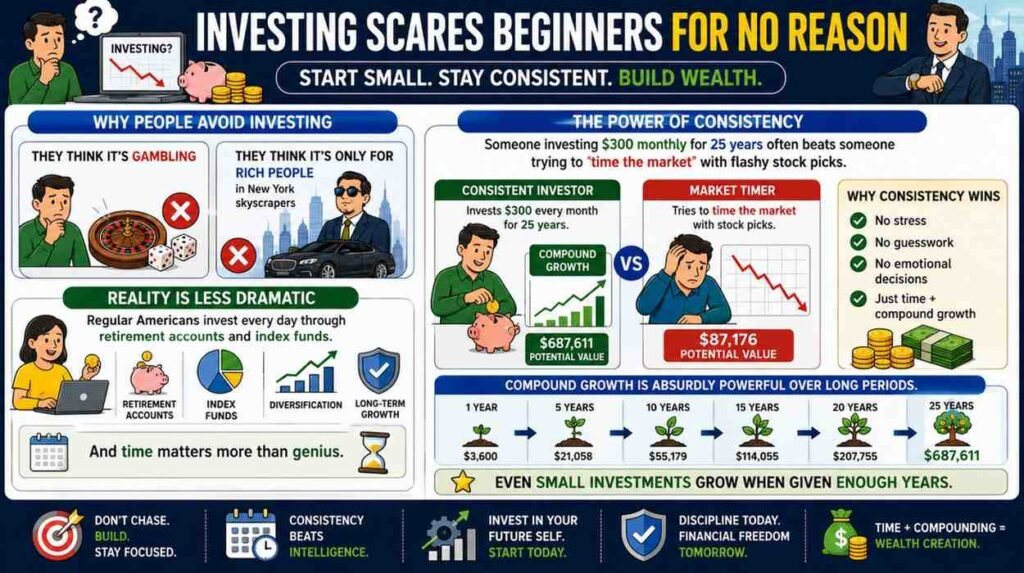
Investing Scares beginners for no reason
A lot of people avoid investing because they think it’s gambling
Or they assume investing is only for rich people wearing expensive watches in New York skycrapers
Reality is less dramatic
Regular Americans invest every day through retirement accounts and index funds
And time matters more than genius
Someone investing $300 monthly for 25 years often beats someone trying to ‘time the market’ with flashy stock picks
That’s because compound growth is absurdly powerful over long periods.
Even small investments grow when given enough years.
Best Beginner Investment Options
401(k)
Many US employers offer this retirement account
Some companies match cotributions
If your employer matches 5% and you ignore it, you’re basically refusing free money.
Roth IRA
You contribute after tax money, and qualified withdrawals later can be tax free.
A lot of younger workers like Roth IRAs because future tax advantages can become massive.
Index Funds
These funds track large markets like the S&P 500
Instead of betting everything on one company, you spread risk across hundreds of businesses
That reduces emotional investing mistakes.
ETFs
Exchange-traded funds work similarly to index funds but trade like stocks.
Popular among beginners because fees are usually lower than actively managed funds.
The Psychology of Spending Matters morethan Apps
People download budgeting apps and expect miracles
Apps help. Behavior matters more
Most spending problems come from emotion
Stress Spending.

Bored Spending.
Revenge Spending after a bad workday.
Retail therapy is real.
Companies spend billions studying consumer psychology because emotional buying works frighteningly well.
That ‘limited time offer’ email wasn’t written accidentally
One practical trick helps a lot :
Wait 24 hours before non essential purchases
You’d be shocked how many ‘must have’ items suddenly feel unnecessary the next day.
Side Income changed personal finance in America
Ten years ago, most people relied mainly on one job.
Now Millions have side income
Freelancing
Content Creation
Onlne Selling
Remote Consulting
Affiliate Marketing
Youtube Channels
Digital Products
Some people earn a few hundred extra dollars monthly. Others build full businesses.
The internet changed financial opportunity completely.
Your phone can waste 5 hours daily.
Or make money
Depends how you use it
Taxes Matter more than people think
Most Americans only think about taxes during filing season.
Bad Idea.
Tax planning affects real wealth
Understanding deductions, retirement contributions, capital gains, and business expenses can save serious money over time.
For Example :
- Traditional 401(k) contributions may reduce taxable income
- Business owners often deduct certain expenses
- Long-term investment gains usually receive lower tax rates than short-term trading profits
People who ignores taxes often overpay without realizing it.
And yes, tax rules change frequently. Staying updated matters.
Debt can quietly destroy financial progress
Not all debt is equal
A mortgage on a reasonably priced house is different from 29% credit card interest funding impulse shopping.
High interest debt grows fast
Very fast
Credit cards become dangerous when people only make minimum payments. Some balances take years to disappear
Student loans also remain a huge burden in the USA.
Millions of borrowers delay home ownership, investing, or family planning because monthly payments consume too much income.
Debt reduction usually works best with one of these approaches.
Snowball Method
Pay smallest balances first
People like this because psychological wins keep motivation high.
Avalanche Method
Pay highest interest debt first.
Mathematically stronger for saving money long term.
Pick whichever system you’ll actually stick with.
Insurance Protects Financial Stability
Insurance feels annoying until disaster happens
Then suddenly it matters a lot
Americans commonly deal with:
- Health Insurance
- Car Insurance
- Home Insurance
- Renters Insurance
- Life Insurance
Skipping coverage to save small monthly costs sometimes creates catastrophic financial damage later.
Medical bills alone bankrupt many families every year.
That’s reality
Still, overpaying is common too
People should compare rates regularly instead of blindly renewing policies forever.
Financial Scams are Getting Smarter
Scammers improved dramatically over the last few years
Fake Investment platforms.
Crypto Scams
Phishing Emails
AI-generated voice Scams
Fake IRS calls
Some scams look frighteningly real now.
Basic Protecting Matters :
- Never share banking codes
- Avoid random investment promises
- Verify websites carefully
- Use strong passwords
- Enable two-factor authentication.
If someone promises guaranteed high returns with zero risk, walk away immediately.
Real investing has risk Always.
Housing Costs Changed Financial Planning
Buying a house became harder for many Americans
Interest rates shifted monthly mortgage payments upward. Home prices in several cities remain expensive despite market cooling in some regions.
That means people need stronger planning before purchasing homes.
Things buyers often underestimate :
- Property Taxes
- Maintenance Costs
- HOA Fees
- Insurance
- Closing Costs
Owning a home can build wealth over decades
It can also trap people financially if they buy beyond their limits.
A massive house payment kills flexibility.
Retirement Arrives Faster than People Expect
People in their 20s think retirement is forever away.
Then suddenly they’re 40 wondering where the time went.
Retirement investing works best when started early because compounding needs time.
Even modest contributions matter.
Someone investing consistently from age 25 often ends up in a far better position than someone starting aggressively at 45.
The years matter more than intensity.
That’s the brutal truth about retirement math.
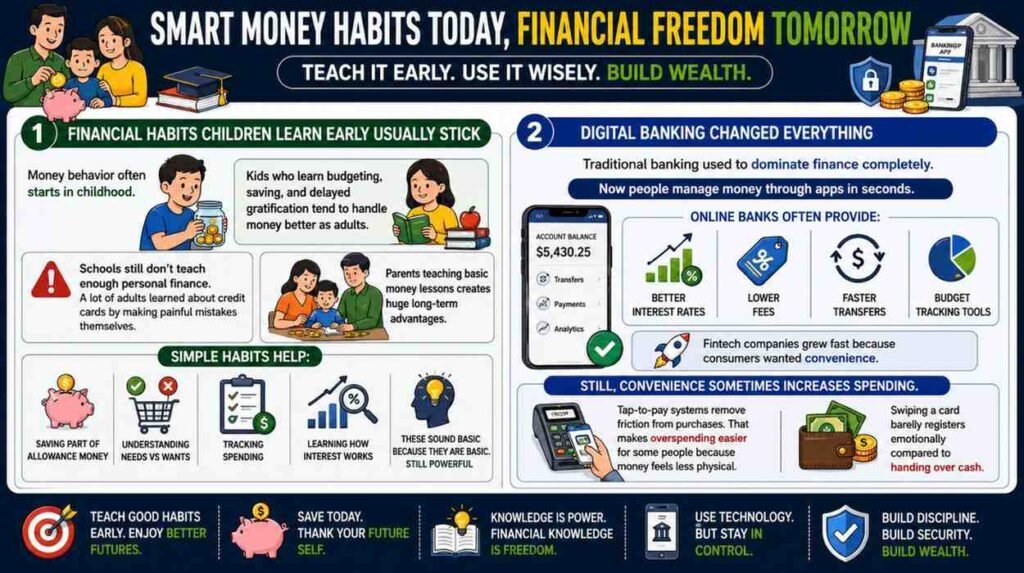
Financial Habits Children Learn Early Usually Stick
Money behavior often starts in childhood.
Kids who learn budgeting, saving, and delayed gratification tend to handle money better as adults.
Schools still don’t teach enough personal finance

A lot of adults learned about credit cards by making painful mistakes themselves.
Parents teaching basic money lessons creates huge long-term advantages.
Simple Habit Help :
- Saving part of allowance money
- Understanding needs vs wants
- Tracking spending
- Learning how interest works
These sound basic because they are basic.
Still Powerful
Digital Banking Changed Everything
Traditional banking used to dominate finance completely.
Now people manage money through apps in seconds.
Online banks often provide :
- Better interest rates
- Lower fees
- Faster transfers
- Budget tracking tools
Fintech companies grew fast because consumers wanted convenience.
Still, convenience sometimes increases spending.
Tap-to-pay systems remove friction from purchases. That makes overspending easier for some people because money feels less physical.
Swiping a card barely registers emotionally compared to handing over cash.
Financial Stress Affects Mental Health
Money pressure changes people.
Sleep Problems
Anxiety
Relationship Arguments
Constant Stress
Financial Instability affects mental health more than many realize.
Couples fight about money constantly in the USA. One person overspends, another over-saves, both get frustrated.
Clear communication matters.
Shared goals matter.
And honesty matters most.
Hidden debt destroys trust quickly.
Building Wealth Usually Looks Boring
Social Media pushes flashy financial fantasies.
Luxury Cars rented for Instagram Photos.
Fake Trading Gurus
‘Passive Income’ Screenshots
People pretending they became millionaires overnight.
Real wealth usually looks boring.
Consistent Investing
Consistent Spending
Stable Income
Long-term Patience
That’s it.
No secret formula hidden in a Dubai Hotel Seminar.
A lot of wealthy people drive normal cars and quietly invest for decades.
Meanwhile, fake rich people spend everything trying to look rich online.
Huge Difference.
How Americans can Improve Finances Faster
These habits consistently help people move forward financially :
Track Spending Weekly
Most people underestimate spending badly
Seeing actual numbers changes behavior
Increase Income Aggressively
Budgeting alone has limits.
Learning skills that raise earning power matters massively.
Avoid Lifestyle Inflation
People get raises and immediately upgrade everything
Apartment
Car
Phone
Vacations
Income raises, savings stay flat.
Automate Savings
Automatic transfers reduce temptation.
People save more when decisions happen automatically.
Learn Basic Investing
You don’t need to become a stock market expert.
Understanding index funds and retirement accounts already puts you ahead of many adults.
Finance Paint and The Future of Money
Money management keeps changing.
AI tools are entering personal finance.
Digital Payments dominate
Remote Work reshapes careers
Online business opportunities keep growing
But human behavior still controls outcomes.
People who manage emotions well usually manage money better too
That probably won’t change anytime soon.
The Fundamentals remain simple :
Spend less than you earn
Avoid destructive debt
Invest consistently
Protect yourself financially
Think long-term.
Simple doesn’t mean easy.
But it works.
And honestly, that’s what finance paint really is.
Building layer after layer of smart financial habits until your life becomes more stable, less stressful, and harder to destroy when problems show up.
For More Updates Please Follow Click Here