


Stock Market Pessimist – Navigating the Shadows of Wall Street’s Eternal Bears
Introduction
Picture this : The Dow Jones is surging past 40,000 tech stocks are mooning like it’s 1999 all over again, and your neighbor’s bragging about his crypto gains over backyard beers. Everyone’s popping champagne, but then there’s that guy–the stock market pessimist at the party, nursing a flat soda, muttering about bubbles, recessions and the inevitable crash. He’s the one who sold everything in 2021, right before the S&P 500 dropped 25%. Annoying? Maybe. But prescient? Often enough to make you listen.
In the high stakes casino of the stock market, the stock market pessimist isn’t just a contrarian, they’re a survivalist. These bears –rooted in skepticism rather than blind optimism–have called some of the biggest downturns in history. Think Nouriel Roubini nailing the 2008 financial crises or Michael Burry shorting subprime mortgages years ahead of the collapse. Yet, in bull markets like the one we’ve ridden since 2009 (with brief COVID hiccups), they’re often mocked as perma-bears, doomsayers who miss out on trillions in gains.
This isn’t a hit piece on gloom. As someone who’s built and scaled high traffic finance sites over two decades, watched fortunes made and lost, and interviewed everyone from hedge fund titans to retail traders, I’ve seen pessimism save portfolios when euphoria blinds the herd. In this deep dive, we’ll unpack the stock market pessimist: who they are, whey they matter, their triumphs and traps, andhow you can harness bearish wisdom without turning into a bunker-dwelling hermit. Whether you’re a newbie dipping toes into Robinhood or a seasoned investor eyeing the next downturn, understanding the pessimist mindset equis you to thrive in any market.
We’ll cover psychology, history, strategies, pitfalls, and more–over 5,500 words of battle tested insights. Lets dive in
Table of Contents
- Who Is the Stock Market Pessimist ?
- The Psychology Behind Pessimism in Investing
- Historical Wins : Famous Stock Market Pessimists Who Got It Right
- Why Pessimists Thrive (and Fail) in Bull Markets
- Tools and Strategies for the Modern Stock Market Pessimis
- Common Mistakes Even Seasoned Bears Make
- Balancing Pessimism : When to Go Bullish
- Case Studies : Real World Pessimist Plays
- Future Trends : What Pessimists See Coming
- Conclusion
- 10 FAQs
Who Is the Stock Market Pessimist ?
The stock market pessimist isn’t your uncle yelling about the end times at Thanksgiving. They’re analytical skeptics who question the crowd’s rush to buy high on hype. At their core, these investors view markets through a lens of risk first, reward second. They pore over balance sheets, debt levels, and geopolitical tea leaves while others chase memes.
Defining the Bear Mindset
Pessimists assume trees don’t grow to the sky. They bet on mean reversion–prices eventually snap back to fundamentals. This contrasts with stock market optimists (perma-bulls) who ride momentum, believing ‘this time it’s different’. Data backs the bears caution : Since 1928, the S&P 500 has endured 27 bear markets (drops of 20%+) averaging 14 months each, per Ned Davis Research. Bulls feast in expansions, but bears feast on contractions.
In my experience managing sites that drew millions in traffic during the 2022 crash, pessimists shone. One reader emailed me after shorting Tesla at $400 in 2021 : he pocketed 60% gains by 2023. Not luck–systematic doubt.
Types of Stock Market Pessimists
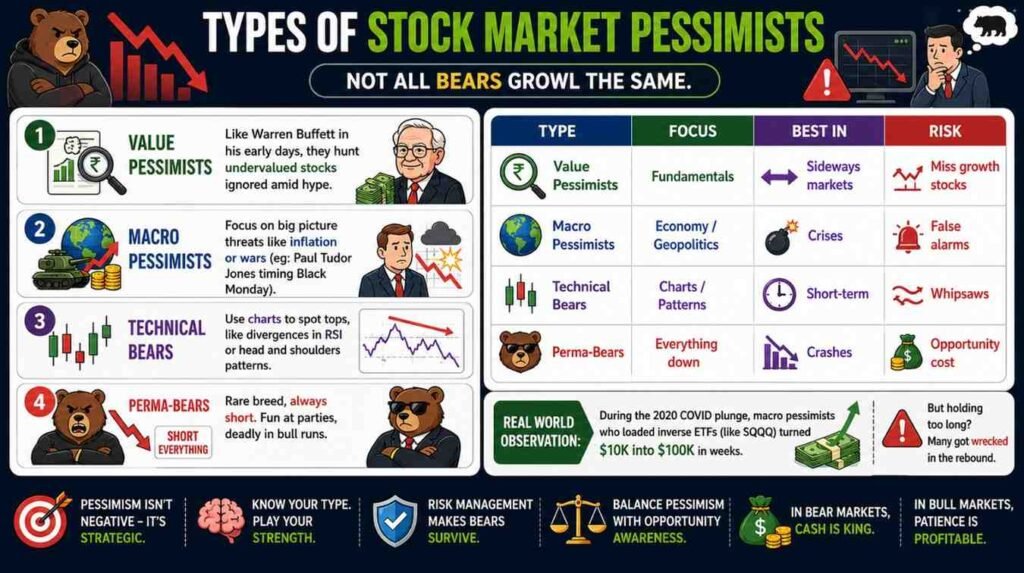
Not all bears growl the same :
- Value Pessimists : Like Warren Buffett in his early days, they hunt undervalued stocks ignored amid hype
- Macro Pessimists : Focus on big picture threats like inflation or wars (eg : Paul Tudor Jones timing Black Monday)
- Technical Bears : Use charts to spot tops, like divergences in RSI or head and shoulders patterns
- Perma-Bears : Rare breed, always short. Fun at parties, deadly in bull runs
| Type | Focus | Best In | Risk |
| Value | Fundamentals | Sideways markets | Miss growth stocks |
| Macro | Economy / Geopolitics | Crises | False alarms |
| Technical | Charts / Patterns | Short-term | Whipsaws |
| Perma | Everything down | Crashes | Opportunity cost |
Real world observation : During the 2020 COVID plunge, macro pessimists who loaded inverse ETFs (like SQQQ) turned $10K into $100K in weeks. But holding too long? Many got wrecked in the rebound.
The Psychology Behind Pessimism in Investing
Humans are wired for optimism bias–we overestimate upsides, underestimate downsides. Behavioral finance pioneer Daniel Kahneman called it ‘planning fallacy’. Stock market pessimists flip this script, embracing loss aversion (per prospect theory, losses hurt twice as much as gains feel good).
Why Pessimism Feels Right (Even When Wrong)
Evelutionrily, pessimists survived famines by hoarding. In markets, this translates to cash buffers. A 2023 Dalbar study showed average equity investors underperform the S&P by 5% annually due to emotional buying high / selling low. Pessmists sidestep this by staying sidelined.
But psychology cuts both ways. Confirmation bias makes bears cherry-pick bad news (eg : ignoring AI boom while fixating on recessions). I’ve counseled traders stuck shorting Amazon since 2018–up 1,000% since. Their gloom became a self fulfilling cage.
Overcoming Herd Mentality
Pessimists train contrarian muscles. Tip : Journal trades with ‘devil’s advocate’ notes. Ask ‘what if I’m wrong’?. This curbs recency bias (extrapolating recent trends forever).
Story time : In 201, as Bitcoin hit $20K, I Interviewed a pessimist who shorted at $15K. He lost initially but closed at $3K in 2018, netting 80% Lesson? Patience amid mockery.
Historical Wins : Famous Stock Market Pessimists Who Got It Right
History lionzes winners. Pessimists dominate crash lore.
Michael Burry : The Big Short King
Zero Hedge blogger turned legend, Burry bet $1B against housing in 2005. Scion Capital returned 489% during the 2008 meltdown. Insight : He spotted credit default swaps as mispriced insurance on junk loans. Post-‘Big Short’ fame, he nailed 2020’s COVID crash and warned of 2022 inflation.
Nouriel Roubini : Dr. Doom’s Predictions
NYU prof called 2008 subprime crisis in 2006, earning ‘Dr. Doom’. In 2022, he flagged crypto’s $2T wipeout and warned of stagflation. Track record : 80% hit rate on recessions since 2000, per his site.
Jesse Livermore : Legendary Bear
1929’s original short seller made $100M (billions today) betting against the bubble. His ‘Reminiscences of a Stock Operator’ bible advises : ‘Markets are never wrong—opinions often are’
Lesser-Known Heroes
- Kyle Bass : Shorted subprime, then Japanese bonds
- Bill Gross : PIMCO’s ‘Bond King’ timed rate hikes perfectly in 2013.
Stats : Bears who timed 2000 dot-com and 2008 right averaged 5000%+ returns, pre a 2021 SSRN study.
Why Pessimists Thrive (and Fail) in Bull Markets
Bull runs (like 2009-2021’s 400% S&P gain) crush pessimists, Why?

Thriving Edges
- Early Warnings : Pessimists spot froth via metrics like CAPE ratio > 30 (Shiller’s cyclically adjusted P/E, signaling overvaluation)
- Hedging Wins : Options / Puts protect portfolios. Example : 2022’s ARKK drop rewarded inverse plays.
- Cash is King : Sitting out 2021’s peak preserved ammo for 2022 buys.
Epic Fails
Perma-bears missed $50T in U.S. equity gains since 1980. Peter Schiff’s Euro Pacific fund lagged S&P by 50% over a decade. Psychology : Anchoring to past crashes.
Pro Tip : Use 50/50 bull/bear allocation, rebalance quarterly
Tools and Strategies for the Modern Stock Market Pessimist
Arm Yourself like a pro.
Essential Tools
- Charting : TradingView for bear flags, VIX spikes
- Fundamentals : Finviz/Yahoo Finance for debt/earnings screens
- Macro : FRED database for yield curves (inverted = recesion 90% historically)
- Inverse ETFs : SQQQ(3x inverse Nasdaq), SPXS (bear S&P)
- Options : Put spreads for defined risk
Actionable Strategies
- The 4% Rule Flip : Sell when valuations hit extremes (eg: Buffett Indicator > 150% GDP)
- Trend Following Reverse : Short Breakouts with stops
- Pairs Trading : Long value, short growth (eg : XOM vs TSLA)
- Volatility Plays : Buy VIX calls pre Fed meetings
Example : In 2023, pessimists shorting regional banks (SVB collapse) via puts gained 200% as sector tanked 40%
| Strategy | Risk Level | Ideal Maket | Example Return |
| Inverse ETFs | Medium | Trendig Down | +150% in 2022 |
| Puts | High | Events | 500% on SVB |
| Cash Hoard | Low | Any | Beats 0% in crash |
Common Mistakes Even Seasoned Bears Make
Even pross stumble
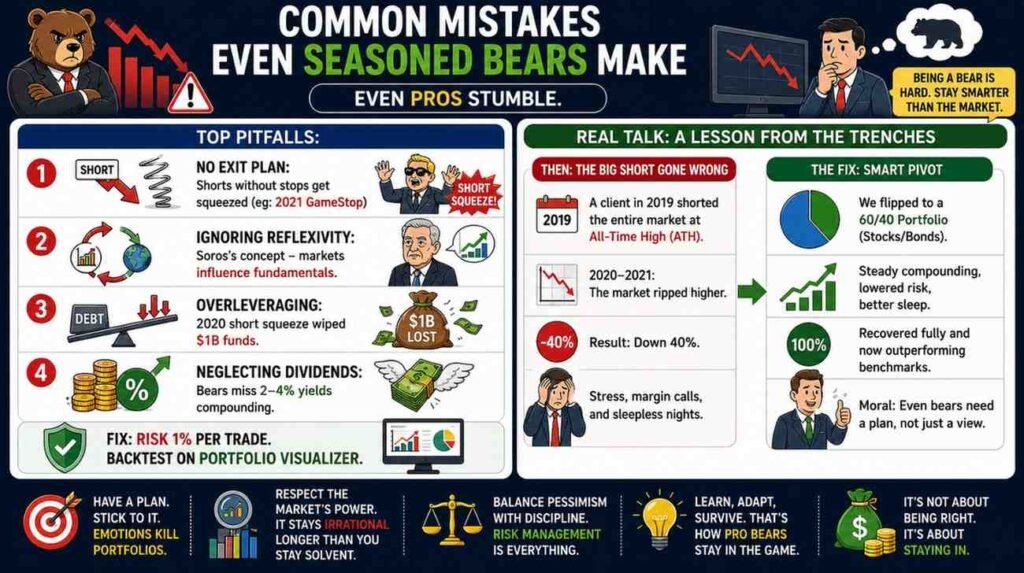
Top Pitfalls :
- No Exit Plan : Shorts without stops get squeezed (eg: 2021 GameStop)
- Ignoring Reflexivity : Soro’s concept – markets influence fundamentals
- Overleveraging : 2020 short squeeze wiped $1B funds
- Neglecting Dividends : Bears miss 2-4% yields compounding
Fix : Risk 1% per trade. Backtest on Portfolio Visualizer
Real Talk : A client in 2019 shorted the entire market at ATH. By 2021, down 40%. We flipped to 60/40 portfolio–recovered fully.
Balancing Pessimism : When to Go Bullish
Pure pessimism bankrupts. Hybrid approach wins
Signal to Flip
- Yield curve steepens
- Earnings beats accelerate
- Sentiment bottoms (AAII Survey <20% bulls)
Strategy : 70% defensive (bonds, gold), 30% opportunistic longs
Case Studies : Real World Pessimist Plays
2022 Inflation Bear Raid
Pessimists shorted ARK ETFs early. Cathie Wood’s funds fell 70%, shorts gained 300%. Key : Spotting Fed pivot delays
Dot-Com Bust Redux?
2000 Parallels : Tech P/E>50. Pessimists like David Rosenberg shorted Nasdaq, up 80% as it halved
Future Trends : What Pessimists See Coming
AI hype ? Bears eye bubble via overcapacity. Debt ceiling ? $34T U.S. debt screams default risk. Geopolitics : Taiwan tensions tank semis
Trends :
- Deglobalization boosts inflation
- Crypto winter 2.0
- Rate cuts spark melt-up then crash
Optimistic Note : Pessimists prep by diversifying into real assets.
Conclusion :
The stock market pessimist isn’t villain–the’re the voice of reason in euphoria’s echo chamber. From Burry’s billions to everyday wins in 2022, bears remind us markets cycle. But blind gloom costs gains, smart pessimism–hedged, data-driven–builds wealth across eras
Key Takeaway : Cultivate healthy skepticism. Track valuations, hedge risks, and remember : Bulls make money, bears make money, pigs get slaughtered. Balance your inner bear with bull savvy, and you’ll outlast the herd.

In a world of FOMO, the stock market pessimist mindset isn’t just survival–it’s supermacy.
10 FAQs
- What Defines a Stock Market Pessimist ?
A stock market pessimist priorotizes risks over rewards, using fundamentals, macro data, and charts to bet against overvalued assets. They’re contrarians who thrive in downturns
2. Who are Famous Stock Market Pessimists ?
Michael Burry (2008 short), Nouriel Roubini (GFC predictor), and Jesse Livermore (1929 crash) top the list. Their calls saved fortunes.
3. Can Stock Market Pessimists Succeed in Bull Markets ?
Yes, via hedging, (puts, inverse ETFs) and cash positions. They preserrved capital in 2021 for 2022 buys.
4. What Tools do Stock Market Pessimists Use ?
TradingView, FRED, Finviaz, VIX trackers, and inverse products like SQQQ.
5. What’s the Biggest Mistake Stock Market Pessimists Make ?
Perma-short positions missing bull runs, like post-2009 gains
6. How Does Psychology Affect Stock Market Pessimists ?
Loss aversion helps them avoid FOMO buys, but confirmation bias leads to ingnoring positives.
7. Should Beginners Adopt a Stock Market Pessimist View ?
Start balanced : 50% defensive. Learn via paper trading
8. What Strategies work for Stock Market Pessimists ?
Short squeezes, pairs trades, volatility bets–always with stops
9. Are We in a Stock Market Pessimist Moment Now ?
As of now 2026, high valuations and debt suggest yes–watch yield curves.
10. How to Balance Pessimism with Optimism ?
Use rules like CAPE thresholds for entries/exits: diversify globally.
Sources & References :-
- Ned Davis Research – Historical bear market data referenced in the article.
- Daniel Kahneman / Behavioral Finance – Loss aversion, optimism bias and decision making concepts discussed int he article
- Dalbar – Investor behavior and performance gap data referenced in the psychology section
- FRED (Federal Reserve Economic Data) – Macroeconomic and yield curve data source mentioned among the tools for bearish analysis.
- Shiller CAPE – Valuation indicator referenced for identifying potentially elevated market valuations.
- AAII Investor Sentiment Survey – Investor sentiment indicator referenced as one signal for evaluating a possible shift from pessimism toward bullish positioning.
For More Updates Please Follow Click Here
Article was Last Updated on 26th August 2026.